


Basic Information
- Common Name: Flank Steak
- Scientific Name: Part of Bos taurus (domestic cattle)
- Category: Meat (Red Meat)
Varieties
Flank steak is a specific cut of beef that comes from the abdominal muscles or lower chest of the cow. There are no varieties within the flank steak itself, but the term “choice” refers to the USDA grade, which indicates high quality with less marbling than the highest grade, “prime,” but more than “select.”
Nutritional Information
- Macronutrients: Flank steak is high in protein and contains a moderate amount of fats, with no carbohydrates. A typical serving (100 grams of raw, choice, boneless flank steak) includes:
- Proteins: About 17.5 grams
- Fats: Approximately 19.4 grams
- Carbohydrates: 0 grams
- Micronutrients: A rich source of vitamins and minerals, including vitamin B12, niacin (B3), vitamin B6, iron, zinc, and selenium.
Phytonutrients
Beef, including ground beef with an 80% lean meat to 20% fat ratio, is not typically a source of phytonutrients because phytonutrients are compounds found in plants. However, beef is a significant source of various nutrients and bioactive compounds beneficial for health. Here’s an overview of the key nutrients and compounds found in ground beef:
1. Proteins and Amino Acids
- Beef is a rich source of complete protein, providing all essential amino acids necessary for muscle growth, repair, and general health.
2. Fats
- Saturated Fats: Present in beef, important for various bodily functions, but should be consumed in moderation.
- Monounsaturated Fats: Also found in beef, beneficial for heart health.
- Omega-3 Fatty Acids: In smaller amounts, especially in grass-fed beef, beneficial for heart health.
- Conjugated Linoleic Acid (CLA): Associated with several health benefits, including reduced body fat and improved immune function.
3. Vitamins
- B Vitamins: Beef is an excellent source of B12, crucial for brain health and blood formation, and provides B3 (niacin), B6, and other B vitamins.
- Fat-Soluble Vitamins: Depending on the beef’s diet, it may also contain vitamins D and E.
4. Minerals
- Iron: Ground beef provides heme iron, which is more easily absorbed by the body than the non-heme iron found in plant sources.
- Zinc: Essential for immune function, wound healing, and DNA synthesis.
- Selenium: Important for antioxidant protection and thyroid health.
5. Bioactive Compounds
- Creatine: Supports muscle function and energy production.
- Carnosine: Beneficial for muscle function and has antioxidant properties.
While ground beef does not contain phytonutrients, the nutrients it does provide, such as high-quality protein, essential vitamins, and minerals, make it a valuable food choice for supporting overall health. Including lean ground beef in a balanced diet can contribute to meeting nutritional needs, especially for iron, zinc, and vitamin B12, which are crucial for various bodily functions.
- Calorie Count: Roughly 160 calories per 100 grams.
- Glycemic Index: Not applicable (meat does not contain carbohydrates).
Physical Characteristics
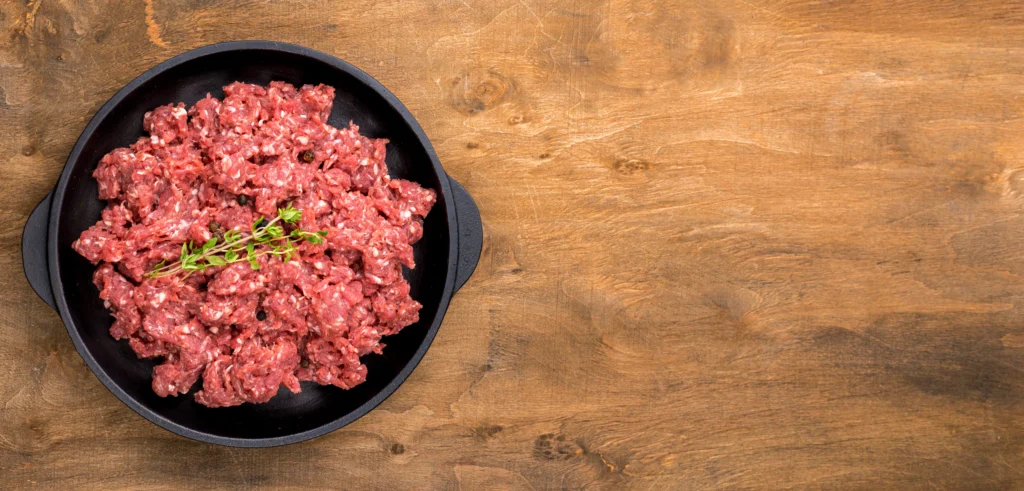
- Color: Raw flank steak is a deep red or purplish color.
- Shape: Long, flat, and thin.
- Size: Typically measures about 12 to 14 inches long and 5 to 6 inches wide, with a thickness of about ½ to ¾ inch.
- Texture: Dense and fibrous with a distinct grain running the length of the meat.
Culinary Uses
Flank steak is prized for its flavor and is best when marinated and cooked quickly over high heat:
- Common Dishes: Often used for fajitas, stir-fries, and grilled dishes. It’s also popularly broiled or pan-seared.
- Preparation Methods: Marinating helps tenderize the meat. It should be sliced against the grain to maximize tenderness.
- Suitable Pairings: Flank steak pairs well with robust marinades and sauces, including those based on soy sauce, lime, garlic, and chili. It complements sides like grilled vegetables, rice, or salads.
Geographical Information
- Origin: Domestic cattle have been an important source of meat for thousands of years, with origins in Europe, Asia, and North Africa.
- Primary Growing Regions: Beef is produced worldwide, with the largest producers being the United States, Brazil, the European Union, and China.
- Seasonal Availability: Available year-round, as beef production is not seasonally dependent.
Flank steak is a flavorful and versatile cut of beef that benefits from specific cooking methods to ensure it remains tender and juicy. Its nutritional profile, rich in protein and essential nutrients, makes it a valuable addition to a balanced diet when consumed in moderation.
| Proximates: | |
| Water | 62.5 g |
| Energy (Atwater General Factors) | 243 kcal |
| Energy (Atwater Specific Factors) | 248 kcal |
| Nitrogen | 2.8 g |
| Protein | 17.5 g |
| Total lipid (fat) | 19.4 g |
| Ash | 0.83 g |
| Carbohydrates: | |
| Carbohydrate, by difference | 0 g |
| Minerals: | |
| Calcium, Ca | 7 mg |
| Iron, Fe | 1.96 mg |
| Magnesium, Mg | 16.4 mg |
| Phosphorus, P | 144 mg |
| Potassium, K | 273 mg |
| Sodium, Na | 55 mg |
| Zinc, Zn | 3.85 mg |
| Copper, Cu | 0.055 mg |
| Manganese, Mn | <0.0125 mg |
| Lipids: | |
| Fatty acids, total saturated | 6.84 g |
| Fatty acids, total monounsaturated | 7.25 g |
| Fatty acids, total polyunsaturated | 0.485 g |
| Fatty acids, total trans | 0.7 g |
| Cholesterol | 68 mg |