

Basic Information
- Common Name: Beef Tenderloin Roast
- Scientific Name: Bos taurus
- Category: Meat (Red Meat)
- Varieties: While the beef tenderloin itself is a specific cut from the loin section of cattle, the categorization here refers to its preparation and quality grade – in this case, “select,” which is a USDA grade indicating a leaner cut with less marbling than “choice” or “prime.”
Nutritional Information
- Macronutrients: The beef tenderloin, especially when trimmed to 0″ fat, is high in protein and low in fat, with no carbohydrates. A typical serving (3 ounces, cooked, roasted) contains:
- Proteins: About 27.7 grams
- Fats: Approximately 5-7 grams
- Carbohydrates: 0 grams
- Micronutrients: A rich source of vitamins B12, B6, niacin, and minerals such as iron, selenium, and zinc.
Phytonutrients
Beef, including the loin tenderloin roast (separable lean only, boneless, trimmed to 0″ fat, select, cooked, roasted), does not contain phytonutrients, as phytonutrients are specific to plant-based foods. However, beef is a significant source of nutrients and bioactive compounds that contribute to its nutritional value. Here’s an overview of the nutrients and bioactive compounds found in cooked beef tenderloin:
1. Proteins and Amino Acids
- Beef tenderloin is an excellent source of complete protein, providing all essential amino acids necessary for muscle repair, growth, and overall health.
2. Fats
- The lean tenderloin, especially trimmed to 0″ fat, has a reduced fat content but still provides essential fatty acids.
- It includes both saturated and monounsaturated fats, with a small amount of polyunsaturated fats.
3. Vitamins
- B Vitamins: Particularly rich in vitamin B12, crucial for nerve function and blood formation. It also provides niacin (B3), vitamin B6, and riboflavin (B2), supporting energy metabolism and overall health.
- Fat-Soluble Vitamins: Depending on the feed and upbringing of the cattle, it may contain vitamins D and E.
4. Minerals
- Iron: Provides heme iron, which is more easily absorbed by the body than non-heme iron from plant sources, important for oxygen transport in the blood.
- Zinc: Essential for immune function, wound healing, and DNA synthesis.
- Selenium: Important for antioxidant protection and thyroid function.
5. Bioactive Compounds
- Creatine: Beneficial for muscle energy storage and performance.
- Carnosine: Has antioxidant properties and can help protect against various degenerative processes in the body.
While beef tenderloin lacks phytonutrients found in plant foods, it is a nutrient-dense food providing a rich source of high-quality protein, vitamins, minerals, and other bioactive compounds beneficial for health. Including lean beef like tenderloin in a balanced diet can contribute to nutrient intake essential for maintaining muscle mass, supporting metabolic functions, and overall well-being.
- Calorie Count: Roughly 165-175 calories per 3-ounce serving.
- Glycemic Index: Not applicable, as it contains no carbohydrates.
Physical Characteristics
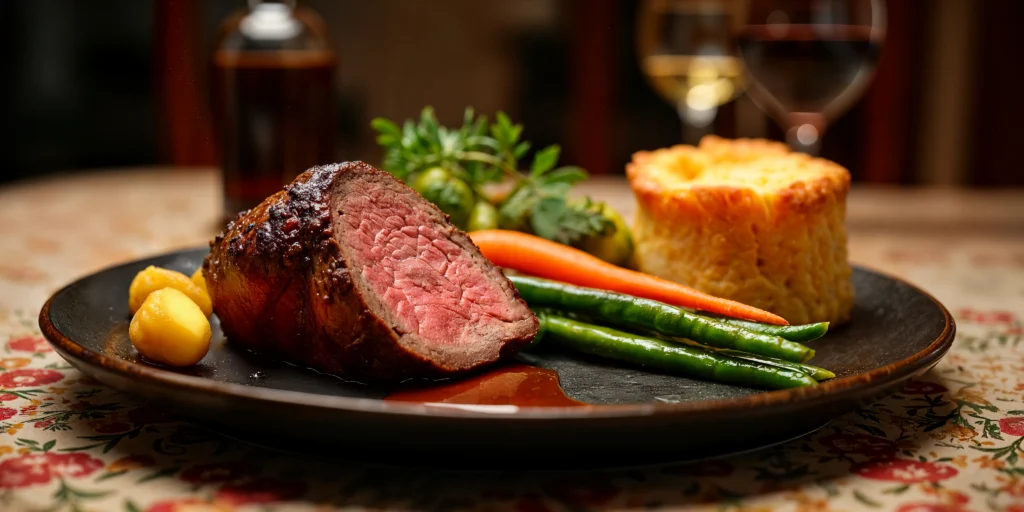
- Color: Cooked beef tenderloin is a rich brown on the outside with a pink to deep red interior, depending on the desired doneness.
- Shape: The tenderloin roast is a long, narrow, and cylindrical cut.
- Size: The size can vary, but tenderloin roasts are typically several pounds before cooking.
- Texture: Known for its tenderness and fine grain, beef tenderloin is one of the most tender cuts available.
Culinary Uses
Beef tenderloin roast is prized for its tenderness and mild flavor, making it suitable for:
- Common Dishes: Often served as the main course, roasted whole or sliced into steaks known as filet mignon.
- Preparation Methods: Best cooked roasted or grilled, often with simple seasonings to highlight its natural flavors. It can be seared on the outside and left rare to medium-rare inside to maximize tenderness.
- Suitable Pairings: Complements a wide range of sides, including roasted vegetables, mashed potatoes, and sauces like béarnaise or red wine reduction.
Geographical Information
- Origin: Domestic cattle have been an integral part of human agriculture for thousands of years, with origins in regions that are now Europe, Asia, and Africa.
- Primary Growing Regions: Beef is produced globally, with leading producers including the United States, Brazil, the European Union, and China.
- Seasonal Availability: Available year-round due to consistent production and distribution methods.
Beef tenderloin, especially when well-trimmed and cooked, offers a luxurious dining experience. Its high protein content and rich sources of essential nutrients, coupled with its unmatched tenderness and versatility in preparation, make it a favorite for special occasions and gourmet meals.
| Proximates: | |
| Water | 65.7 g |
| Energy (Atwater General Factors) | 168 kcal |
| Energy (Atwater Specific Factors) | 176 kcal |
| Protein | 27.7 g |
| Total lipid (fat) | 6.36 g |
| Total fat (NLEA) | 5.56 g |
| Ash | 1.22 g |
| Carbohydrates: | |
| Carbohydrate, by difference | 0 g |
| Minerals: | |
| Calcium, Ca | 13 mg |
| Iron, Fe | 3.04 mg |
| Magnesium, Mg | 13.7 mg |
| Phosphorus, P | 259 mg |
| Potassium, K | 352 mg |
| Sodium, Na | 54 mg |
| Zinc, Zn | 3.7 mg |
| Copper, Cu | 0.097 mg |
| Manganese, Mn | 0.008 mg |
| Selenium, Se | 25.04 µg |
| Vitamins and Other Components: | |
| Riboflavin | 0.4 mg |
| Niacin | 5.76 mg |
| Vitamin B-6 | 0.67 mg |
| Vitamin B-12 | 4.21 µg |
| Lipids: | |
| Fatty acids, total saturated | 2.47 g |
| SFA 10:0 | 0.005 g |
| SFA 12:0 | 0.006 g |
| SFA 14:0 | 0.153 g |
| SFA 15:0 | 0.03 g |
| SFA 16:0 | 1.34 g |
| SFA 17:0 | 0.073 g |
| SFA 18:0 | 0.85 g |
| SFA 20:0 | 0.005 g |
| SFA 24:0 | 0.006 g |
| Fatty acids, total monounsaturated | 2.26 g |
| MUFA 14:1 c | 0.031 g |
| MUFA 16:1 c | 0.141 g |
| MUFA 17:1 | 0.047 g |
| MUFA 17:1 c | 0.047 g |
| MUFA 18:1 c | 2.03 g |
| MUFA 20:1 | 0.012 g |
| MUFA 20:1 c | 0.012 g |
| Fatty acids, total polyunsaturated | 0.472 g |
| PUFA 18:2 c | 0.362 g |
| PUFA 18:2 n-6 c,c | 0.329 g |
| PUFA 18:2 CLAs | 0.033 g |
| PUFA 18:3 c | 0.012 g |
| PUFA 18:3 n-3 c,c,c (ALA) | 0.012 g |
| PUFA 20:2 c | 0.002 g |
| PUFA 20:2 n-6 c,c | 0.002 g |
| PUFA 20:3 c | 0.016 g |
| PUFA 20:3 n-6 | 0.016 g |
| PUFA 20:4 | 0.064 g |
| PUFA 20:4c | 0.064 g |
| PUFA 20:5c | 0.002 g |
| PUFA 20:5 n-3 (EPA) | 0.002 g |
| PUFA 22:5 c | 0.011 g |
| PUFA 22:5 n-3 (DPA) | 0.011 g |
| PUFA 22:6 c | 0.002 g |
| PUFA 22:6 n-3 (DHA) | 0.002 g |
| Fatty acids, total trans | 0.359 g |
| Fatty acids, total trans-monoenoic | 0.326 g |
| TFA 16:1 t | 0.022 g |
| TFA 18:1 t | 0.303 g |
| Fatty acids, total trans-dienoic | 0.034 g |
| TFA 18:2 t not further defined | 0.034 g |
| Cholesterol | 85 mg |