
Basic Information
Common Name: Green Cabbage
Scientific Name: Brassica oleracea var. capitata
Category: Vegetable
Varieties: There are several varieties of green cabbage, including ‘Stonehead’, ‘Golden Acre’, ‘Early Jersey Wakefield’, and ‘Danish Ballhead’, each with subtle differences in taste, size, and growing conditions.
Nutritional Information
Green cabbage is a low-calorie vegetable rich in nutrients.
Macronutrients:
Carbohydrates: About 6.38g per 100g serving
Proteins: About 0.96g per 100g serving
Fats: Negligible; less than 0.23g per 100g serving
Micronutrients: High in Vitamin K, Vitamin C, and folate. It also contains significant amounts of Vitamin B6, calcium, potassium, and magnesium.
Phytonutrients:
Green cabbage is a nutrient-dense vegetable that contains a wide range of phytonutrients, compounds that contribute to its health benefits beyond its basic nutritional content. These phytonutrients include a variety of antioxidants, anti-inflammatory agents, and compounds that may have anti-cancer properties. Here’s a detailed look at the phytonutrients present in raw green cabbage:
1. Glucosinolates
Green cabbage is particularly rich in glucosinolates, sulfur-containing compounds that have been shown to have cancer-protective properties. When cabbage is chopped or chewed, these compounds are converted into isothiocyanates (ITCs) and indoles, which have been studied for their potential to reduce the risk of certain cancers.
2. Flavonoids
- Kaempferol: An antioxidant that may reduce the risk of chronic diseases by combating oxidative stress.
- Quercetin: Known for its anti-inflammatory and antioxidant properties, quercetin can help reduce the risk of heart disease, cancer, and other conditions.
- Apigenin: This compound has been shown to have anti-cancer, anti-inflammatory, and antiviral properties.
3. Phenolic Acid
- Sinapic acid: Acts as an antioxidant and may protect against heart disease, cancer, and age-related disease
- Ferulic acid: Another antioxidant that helps to neutralize harmful free radicals in the body.
4. Anthocyanins (in red cabbage)
Though not present in green cabbage, it’s worth noting that red cabbage contains anthocyanins, which are powerful antioxidants that give red cabbage its color. These compounds have been linked to a reduced risk of cardiovascular disease, cognitive decline, and certain cancers.
5. Vitamin C
While technically a vitamin, vitamin C in cabbage acts as a potent antioxidant, protecting the body’s cells from damage by free radicals and supporting immune function.
6. Vitamin K
Vitamin K functions as a phytonutrient by playing a crucial role in blood clotting and bone health.
7. Fiber
Dietary fiber, though not a phytonutrient, contributes to gut health, helps prevent constipation, and may reduce the risk of chronic diseases.
8. Sulforaphane
Derived from glucosinolates, sulforaphane is a compound with potent anti-cancer properties. It is particularly effective in targeting cancer stem cells and has been shown to improve heart health.
9. Health Benefits
The phytonutrients in green cabbage are linked to numerous health benefits, including:
- Reducing inflammation
- Protecting against certain types of cancer
- Enhancing heart health
- Improving digestion
- Supporting the immune system
- Protecting against oxidative stress
Regular consumption of green cabbage as part of a balanced diet can contribute to overall health and well-being, leveraging the synergistic effects of these diverse phytonutrients.
Calorie Count: Approximately 25 calories per 100g serving
Glycemic Index: Low (GI < 10 for raw cabbage)
Physical Characteristics
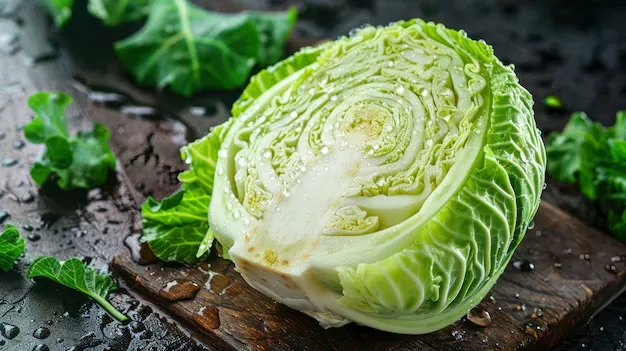
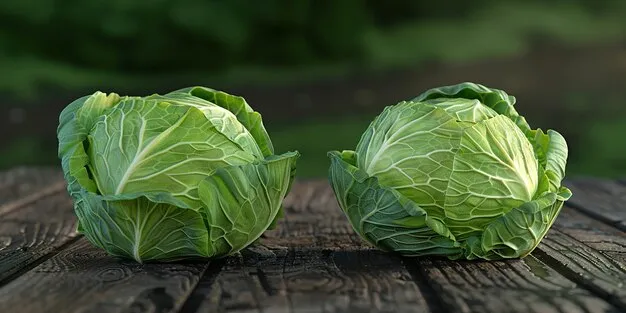
Color: Light to dark green, sometimes with a slightly bluish tint
Shape: Round, dense head of layered leaves
Size: Typically ranges from 0.5 to 4 kg (1 to 9 lbs) in weight, depending on the variety and growing conditions
Texture: Crisp and crunchy when raw
Culinary Uses
Green cabbage is versatile in the kitchen. It can be eaten raw in salads and coleslaws, steamed, sautéed, or added to soups and stews. It’s also commonly used in fermentation to make sauerkraut. Suitable pairings include apples, carrots, potatoes, onions, meats (especially pork), and creamy or vinaigrette dressings.
Geographical Information
Origin: The exact origin is not definitively known, but it is believed to have been domesticated in Europe before 1000 BC.
Primary Growing Regions: Widely grown globally, with major producers including China, India, Russia, and countries in Europe.
Seasonal Availability: Available year-round, with peak season in the fall and winter months.
Green cabbage is a staple vegetable in many cuisines around the world, prized for its nutritional content, culinary versatility, and ability to be stored for relatively long periods compared to other vegetables.
| Proximates: | |
|---|---|
| Water | 91.09 g |
| Energy (Atwater General Factors) | 31 kcal |
| Energy (Atwater Specific Factors) | 28 kcal |
| Nitrogen | 0.15 g |
| Protein | 0.96 g |
| Total lipid (fat) | 0.23 g |
| Ash | 0.56 g |
| Carbohydrate: | |
| Carbohydrate, by difference | 6.38 g |
| Minerals: | |
| Calcium, Ca | 42 mg |
| Iron, Fe | 0.07 mg |
| Magnesium, Mg | 13.9 mg |
| Phosphorus, P | 27 mg |
| Potassium, K | 207 mg |
| Sodium, Na | 16 mg |
| Zinc, Zn | 0.21 mg |
| Copper, Cu | <0.025 mg |
| Manganese, Mn | 0.248 mg |
| Molybdenum, Mo | 6.9 µg |
| Vitamins and other components: | |
| Vitamin C, total ascorbic acid | 40.3 mg |
| Vitamin B-6 | 0.138 mg |
| Vitamin K (phylloquinone) | 59.4 µg |
| Vitamin K (Dihydrophylloquinone) | <0.1 µg |
| Vitamin K (Menaquinone-4) | <0.1 µg |