

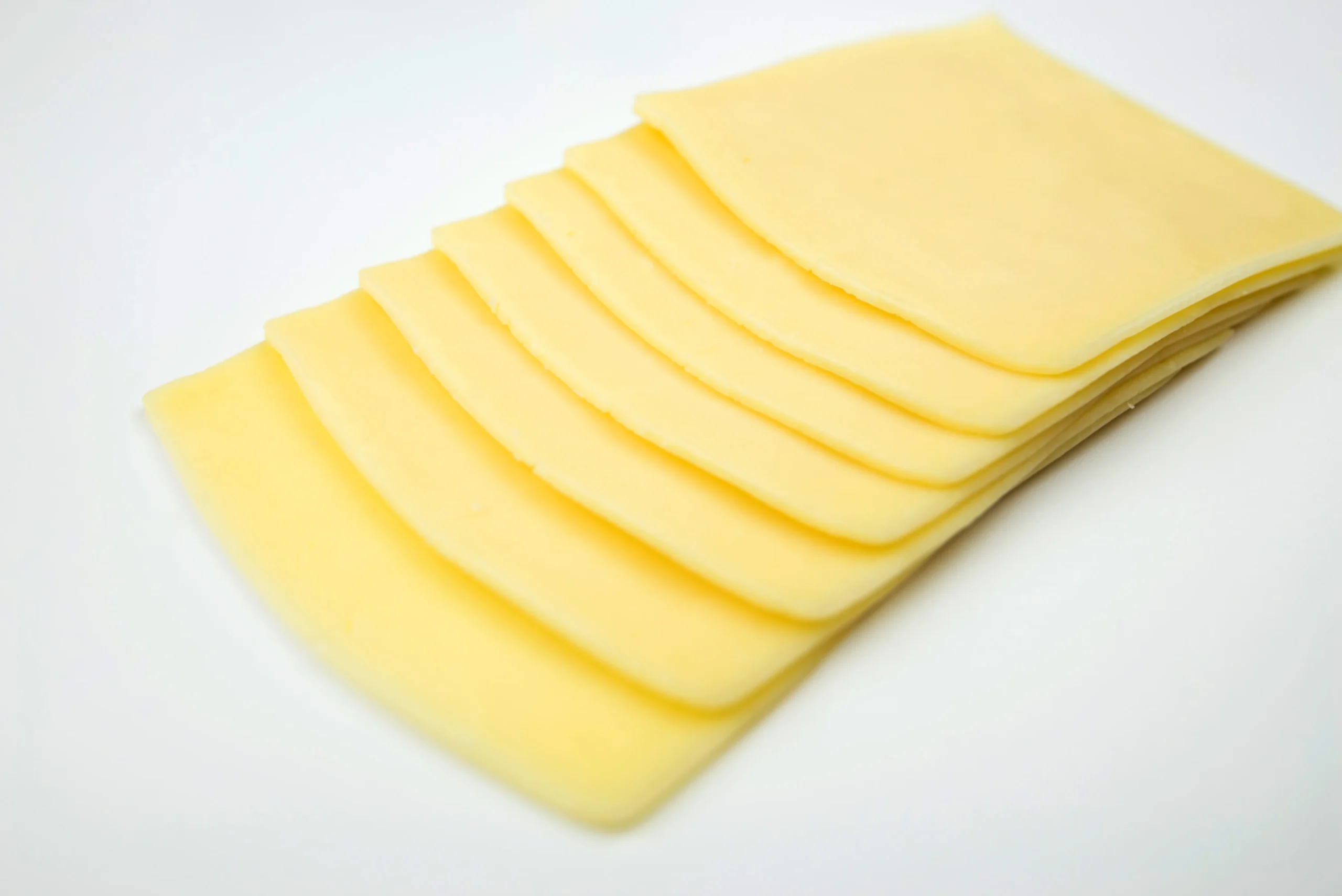
Basic Information
- Name (Common): American Cheese, Vitamin D Fortified
- Scientific: Not applicable, as this refers to a processed food product rather than a species.
- Category: Dairy product, Processed cheese.
- Varieties: The main variations within fortified American cheese depend on the level of fat (regular, reduced-fat, and fat-free) and the type of milk used (whole, 2%, 1%, skim), along with the degree of Vitamin D fortification.
Nutritional Information
Macronutrients
- Carbohydrates: Generally low, around 1-2 grams per 100 grams.
- Proteins: About 16-20 grams per 100 grams, providing a significant source of dairy protein.
- Fats: Varies by type; full-fat versions contain about 20-25 grams per 100 grams, while reduced-fat or fat-free versions will have less.
Micronutrients
- High in Calcium, important for bone health.
- Fortified with Vitamin D, enhancing calcium absorption and bone health.
- Contains Phosphorus, Zinc, and Vitamins A and B12.
phytonutrients
Pasteurized process American cheese, even when fortified with Vitamin D, is primarily recognized for its macro- and micronutrient content rather than phytonutrients, as phytonutrients are typically associated with plant-based foods. However, like other dairy products, it can contain certain bioactive compounds that offer health benefits. Since American cheese is a processed product, the focus is usually on added nutrients (like Vitamin D) and basic components such as fats, proteins, and carbohydrates. Here’s an overview of the relevant compounds and nutrients in Vitamin D fortified American cheese:
Bioactive Compounds in Vitamin D Fortified American Cheese
- Vitamin D: While not a phytonutrient, the fortification of American cheese with Vitamin D is significant for enhancing calcium absorption and promoting bone health. Vitamin D fortification addresses dietary deficiencies and supports overall wellness.
- Conjugated Linoleic Acid (CLA): Present in dairy products, CLA has been researched for its potential health benefits, including anti-inflammatory and anti-carcinogenic effects. The content in processed cheese like American cheese may be lower compared to natural cheeses but is still present in small amounts.
- Butyric Acid: A short-chain fatty acid found in dairy fat, known for its role in gut health and anti-inflammatory properties. The concentration in processed products like American cheese is likely lower than in natural dairy fats.
- Bioactive Peptides: Though the processing of cheese can affect the presence and activity of bioactive peptides, these compounds, derived from the protein in milk, may offer various health benefits, including antimicrobial and immunomodulatory effects. The degree to which they are present in processed American cheese is uncertain.
Considerations
- The processing involved in creating American cheese, including pasteurization and the addition of emulsifiers, colors, and preservatives, may reduce the concentration of naturally occurring bioactive compounds found in the milk used to make cheese.
- The primary health benefit of Vitamin D fortified American cheese is its contribution to improving Vitamin D intake, crucial for bone health and immune function.
In summary, while Vitamin D fortified American cheese contains added vitamins and some bioactive compounds like CLA and potentially bioactive peptides, it does not have a wide range of phytonutrients compared to plant-based foods. Its nutritional value is more focused on providing a source of calcium, protein, fat, and fortified Vitamin D, making it beneficial within a balanced diet, especially for those needing to increase their Vitamin D levels.

Calorie Count and Glycemic Index
- Calorie Count: Approximately 300-350 calories per 100 grams, varying with fat content.
- Glycemic Index: Very low; contains minimal carbohydrates.
Physical Characteristics
- Color: Creamy white to orange-yellow, often influenced by coloring agents like annatto.
- Shape: Comes in individual slices, commonly square, packaged for convenience.
- Size: Standard slices, typically around 2×2 inches, though size can vary by brand.
- Texture: Smooth, creamy, and uniform, designed for easy melting and spreading.
Culinary Uses
- Common Dishes: Widely used in sandwiches, cheeseburgers, grilled cheese sandwiches, and as a creamy melt in various cooked dishes.
- Preparation Methods: Ready to use from the package; melts well when heated, making it ideal for cooking and baking.
- Suitable Pairings: Pairs well with a wide range of foods, including bread, meats (especially burgers and deli sandwiches), tomatoes, and is often used in making cheese sauces due to its smooth melting quality.
Geographical Information
- Origin: United States, developed to have a longer shelf life and consistent melting properties.
- Primary Growing Regions: Produced extensively across the U.S., with no specific region tied to its production.
- Seasonal Availability: Available year-round, with production and distribution designed to ensure constant availability.
American cheese fortified with Vitamin D is a processed cheese product tailored for enhanced nutritional benefits, notably improved bone health through the addition of Vitamin D. This fortification aims to address common dietary deficiencies and support overall health, making it a practical choice for those looking to increase their Vitamin D intake through diet.
| Proximates: | |
| Water | 39.6 g |
| Energy (Atwater General Factors) | 368 kcal |
| Energy (Atwater Specific Factors) | 366 kcal |
| Nitrogen | 2.82 g |
| Protein | 18 g |
| Total lipid (fat) | 30.6 g |
| Total fat (NLEA) | 27.6 g |
| Ash | 6.59 g |
| Carbohydrates: | |
| Carbohydrate, by difference | 5.27 g |
| Sugars, Total | 2.63 g |
| Sucrose | 0 g |
| Glucose | 0 g |
| Fructose | 0 g |
| Lactose | 2.5 g |
| Maltose | 0 g |
| Galactose | 0.13 g |
| Minerals: | |
| Calcium, Ca | 866 mg |
| Iron, Fe | 0.48 mg |
| Magnesium, Mg | 25.1 mg |
| Phosphorus, P | 540 mg |
| Potassium, K | 149 mg |
| Sodium, Na | 1660 mg |
| Zinc, Zn | 2.42 mg |
| Copper, Cu | 0.046 mg |
| Manganese, Mn | 0.038 mg |
| Selenium, Se | 20.4 µg |
| Vitamins and Other Components: | |
| Thiamin | 0.015 mg |
| Riboflavin | 0.247 mg |
| Niacin | 0.095 mg |
| Pantothenic acid | 0.415 mg |
| Vitamin B-6 | 0.056 mg |
| Choline, total | 19.2 mg |
| Choline, free | 2.6 mg |
| Choline, from phosphocholine | 0.7 mg |
| Choline, from phosphatidylcholine | 5.9 mg |
| Choline, from glycerophosphocholine | 4.5 mg |
| Choline, from sphingomyelin | 5.6 mg |
| Betaine | 2.7 mg |
| Vitamin B-12 | 1.45 µg |
| Vitamin A, RAE | 300 µg |
| Retinol | 297 µg |
| Carotene, beta | 26 µg |
| Carotene, alpha | 0 µg |
| Cryptoxanthin, beta | 4 µg |
| Lycopene | 0 µg |
| Lutein + zeaxanthin | 16 µg |
| Vitamin E (alpha-tocopherol) | 0.79 mg |
| Tocopherol, beta | 0 mg |
| Tocopherol, gamma | 0.13 mg |
| Tocopherol, delta | 0.04 mg |
| Tocotrienol, alpha | 0.02 mg |
| Tocotrienol, beta | 0.01 mg |
| Tocotrienol, gamma | 0.06 mg |
| Tocotrienol, delta | 0.04 mg |
| Vitamin D (D2 + D3), International Units | 301 IU |
| Vitamin D (D2 + D3) | 7.5 µg |
| Vitamin D2 (ergocalciferol) | 0 µg |
| Vitamin D3 (cholecalciferol) | 7.5 µg |
| Vitamin K (phylloquinone) | 3.2 µg |
| Vitamin K (Menaquinone-4) | 10.3 µg |
| Lipids: | |
| Fatty acids, total saturated | 18.1 g |
| SFA 4:0 | 0.616 g |
| SFA 6:0 | 0.509 g |
| SFA 8:0 | 0.333 g |
| SFA 10:0 | 0.801 g |
| SFA 11:0 | 0.018 g |
| SFA 12:0 | 0.882 g |
| SFA 14:0 | 2.93 g |
| SFA 15:0 | 0.311 g |
| SFA 16:0 | 8.15 g |
| SFA 17:0 | 0.19 g |
| SFA 18:0 | 3.24 g |
| SFA 20:0 | 0.046 g |
| SFA 22:0 | 0.021 g |
| SFA 24:0 | 0.009 g |
| Fatty acids, total monounsaturated | 7.3 g |
| MUFA 14:1 c | 0.241 g |
| MUFA 15:1 | 0 g |
| MUFA 16:1 c | 0.395 g |
| MUFA 17:1 | 0.061 g |
| MUFA 17:1 c | 0.061 g |
| MUFA 18:1 c | 6.38 g |
| MUFA 20:1 | 0.223 g |
| MUFA 20:1 c | 0.223 g |
| MUFA 22:1 c | 0.001 g |
| MUFA 24:1 c | 0.001 g |
| Fatty acids, total polyunsaturated | 1.09 g |
| PUFA 18:2 c | 0.827 g |
| PUFA 18:2 n-6 c,c | 0.808 g |
| PUFA 18:2 CLAs | 0.019 g |
| PUFA 18:3 c | 0.14 g |
| PUFA 18:3 n-3 c,c,c (ALA) | 0.138 g |
| PUFA 18:3 n-6 c,c,c | 0.001 g |
| PUFA 18:4 | 0.007 g |
| PUFA 20:2 c | 0.009 g |
| PUFA 20:2 n-6 c,c | 0.009 g |
| PUFA 20:3 c | 0.035 g |
| PUFA 20:3 n-3 | 0.001 g |
| PUFA 20:3 n-6 | 0.034 g |
| PUFA 20:4 | 0.045 g |
| PUFA 20:4c | 0.045 g |
| PUFA 20:5c | 0.012 g |
| PUFA 20:5 n-3 (EPA) | 0.012 g |
| PUFA 22:2 | 0.004 g |
| PUFA 22:5 c | 0.021 g |
| PUFA 22:4 | 0.008 g |
| PUFA 22:5 n-3 (DPA) | 0.021 g |
| PUFA 22:6 c | 0.006 g |
| PUFA 22:6 n-3 (DHA) | 0.006 g |
| Fatty acids, total trans | 1.15 g |
| Fatty acids, total trans-monoenoic | 0.947 g |
| TFA 16:1 t | 0.104 g |
| TFA 18:1 t | 0.842 g |
| TFA 22:1 t | 0.001 g |
| Fatty acids, total trans-dienoic | 0.2 g |
| TFA 18:2 t not further defined | 0.2 g |
| Cholesterol | 98 mg |