

Basic Information
- Name (Common): Swiss Cheese
- Scientific: Not applicable, as this term refers to a variety of cheeses produced in Switzerland, rather than a specific species. The most internationally recognized variety is called Emmental or Emmentaler.
- Category: Dairy product, Cheese.
- Varieties: There are many types of Swiss cheese, including Emmental, Gruyère, Appenzeller, and Raclette, each with distinct characteristics in flavor, texture, and hole formation.
Nutritional Information
Macronutrients
- Carbohydrates: Very low, typically less than 1 gram per 100 grams, primarily from lactose.
- Proteins: High, about 27 grams per 100 grams, providing a significant source of high-quality protein.
- Fats: Moderate, around 28 grams per 100 grams, with a mix of saturated and unsaturated fats.
Micronutrients
- Rich in Calcium, crucial for bone health.
- Contains Phosphorus, Zinc, Selenium, and Vitamin B12.
- Provides Vitamin A and Riboflavin (B2).
phytonutrients
Swiss cheese, like other dairy products, is not typically a significant source of phytonutrients, which are naturally occurring compounds found in plants known for their health benefits. However, Swiss cheese does contain several bioactive compounds and nutrients that offer health benefits. Here’s an overview of these compounds in Swiss cheese:
Bioactive Compounds and Nutrients in Swiss Cheese
- Conjugated Linoleic Acid (CLA): Swiss cheese contains CLA, a fatty acid associated with several health benefits, including reduced body fat and improved immune function. Dairy products are among the primary dietary sources of CLA, and its content can vary depending on the diet of the cows.
- Butyric Acid: A short-chain fatty acid present in dairy fat, butyric acid is beneficial for colon health and has anti-inflammatory properties. It’s a product of fermentation, both in the cheese-making process and by gut microbiota when dairy is consumed.
- Bioactive Peptides: The fermentation process and protein breakdown in cheese lead to the formation of bioactive peptides, which have been shown to have various health benefits, including antihypertensive, antimicrobial, and immunomodulatory effects.
- Sphingolipids: Present in dairy fat, sphingolipids have been studied for their potential role in inhibiting the development of colon cancer and other health benefits related to cellular structure and signaling.
Micronutrients
Swiss cheese is also a rich source of several important micronutrients, contributing to its health benefits:
- Calcium and Phosphorus: Essential for bone health and metabolic functions.
- Vitamin B12: Crucial for red blood cell formation and neurological function.
- Zinc and Selenium: Important for immune function and antioxidant protection.
- Vitamin A and Riboflavin (B2): Support vision health, skin health, and energy metabolism.
Considerations
While the focus on Swiss cheese often centers on its macro- and micronutrient content, the bioactive compounds present contribute to its overall nutritional profile. These compounds, such as CLA and bioactive peptides, can have positive effects on health, particularly in the context of a balanced diet.
It’s important to note, however, that due to its high saturated fat content, cheese should be consumed in moderation as part of a varied diet to balance intake of different fats and maintain overall heart health. Swiss cheese, with its rich flavor and healthful nutrients, can be a valuable part of such a diet when consumed wisely.
Calorie Count and Glycemic Index
- Calorie Count: Approximately 380 calories per 100 grams.
- Glycemic Index: Very low, due to its minimal carbohydrate content.
Physical Characteristics
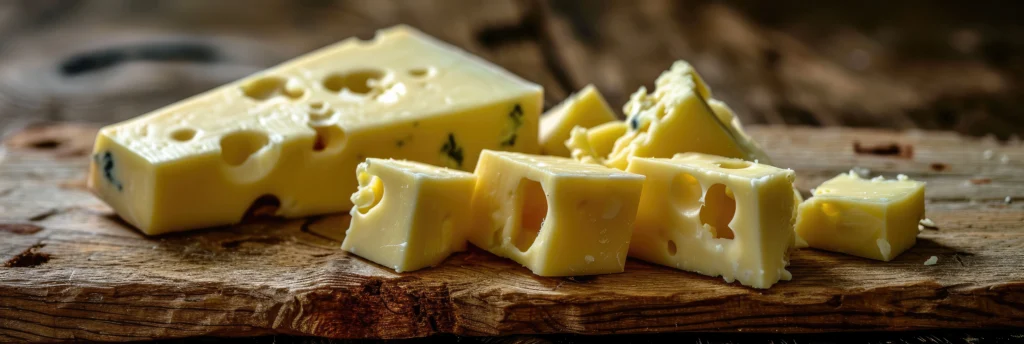
- Color: Pale yellow.
- Shape: Large wheels or blocks, often with distinctive holes (“eyes”) throughout.
- Size: Wheels can weigh between 75 to 100 kilograms (165 to 220 pounds).
- Texture: Smooth, slightly firm but yielding, with a creamy meltability.
Culinary Uses
- Common Dishes: Used in sandwiches, on burgers, in fondues, and as a melting cheese in various baked dishes and casseroles.
- Preparation Methods: Can be sliced, shredded, or melted. Swiss cheese is renowned for its meltability, making it ideal for hot sandwiches, gratins, and sauces.
- Suitable Pairings: Pairs well with fruits like apples and pears, nuts, and hearty bread. It complements wines, especially white wines and lighter reds, and can be served with cured meats in charcuterie boards.
Geographical Information
- Origin: Switzerland, with a history dating back several centuries. The name “Swiss cheese” is used internationally to describe cheeses that resemble the Swiss Emmental.
- Primary Growing Regions: Produced in various regions of Switzerland, each with its own specific varieties. Emmental cheese, for example, originates from the Emme Valley in the canton of Bern.
- Seasonal Availability: Available year-round, with consistent production methods that ensure a steady supply.
Swiss cheese is celebrated not only for its distinctive appearance and excellent melting qualities but also for its nutty, sweet, and sometimes slightly sharp flavor profile. Its versatility in the kitchen and nutritional benefits make it a popular choice worldwide, transcending its Swiss origins to become a staple in many international cuisines.
| proximates: | |
| Water | 37.6 g |
| Energy (Atwater General Factors) | 393 kcal |
| Energy (Atwater Specific Factors) | 393 kcal |
| Nitrogen | 4.23 g |
| Protein | 27 g |
| Total lipid (fat) | 31 g |
| Total fat (NLEA) | 27.6 g |
| Ash | 2.97 g |
| Carbohydrates: | |
| Carbohydrate, by difference | 1.44 g |
| Sugars, Total | 0 g |
| Sucrose | 0 g |
| Glucose | 0 g |
| Fructose | 0 g |
| Lactose | 0 g |
| Maltose | 0 g |
| Galactose | 0 g |
| Minerals: | |
| Calcium, Ca | 890 mg |
| Iron, Fe | 0.13 mg |
| Magnesium, Mg | 33.4 mg |
| Phosphorus, P | 574 mg |
| Potassium, K | 71 mg |
| Sodium, Na | 185 mg |
| Zinc, Zn | 4.37 mg |
| Copper, Cu | 0.047 mg |
| Manganese, Mn | 0.027 mg |
| Selenium, Se | 30.1 µg |
| Vitamins and Other Components: | |
| Thiamin | 0.011 mg |
| Riboflavin | 0.303 mg |
| Niacin | 0.06 mg |
| Pantothenic acid | 0.352 mg |
| Vitamin B-6 | 0.07 mg |
| Folate, total | 9 µg |
| Choline, total | 13.8 mg |
| Choline, free | 3.3 mg |
| Choline, from phosphocholine | 0.1 mg |
| Choline, from phosphatidylcholine | 6 mg |
| Choline, from glycerophosphocholine | 0 mg |
| Choline, from sphingomyelin | 4.4 mg |
| Betaine | 0.1 mg |
| Vitamin B-12 | 3.02 µg |
| Vitamin A, RAE | 292 µg |
| Retinol | 287 µg |
| Carotene, beta | 60 µg |
| Carotene, alpha | 1 µg |
| Cryptoxanthin, beta | 2 µg |
| Lycopene | 1 µg |
| Lutein + zeaxanthin | 8 µg |
| Vitamin E (alpha-tocopherol) | 0.6 mg |
| Tocopherol, beta | 0.02 mg |
| Tocopherol, gamma | 0.08 mg |
| Tocopherol, delta | 0 mg |
| Tocotrienol, alpha | 0.13 mg |
| Tocotrienol, beta | 0 mg |
| Tocotrienol, gamma | 0 mg |
| Tocotrienol, delta | 0 mg |
| Vitamin D (D2 + D3), International Units | 0 IU |
| Vitamin D (D2 + D3) | 0 µg |
| Vitamin D2 (ergocalciferol) | 0 µg |
| Vitamin D3 (cholecalciferol) | 0 µg |
| Vitamin K (phylloquinone) | 1.4 µg |
| Vitamin K (Dihydrophylloquinone) | 0 µg |
| Vitamin K (Menaquinone-4) | 6.3 µg |
| Lipids: | |
| Fatty acids, total saturated | 18.2 g |
| SFA 4:0 | 0.679 g |
| SFA 6:0 | 0.541 g |
| SFA 8:0 | 0.326 g |
| SFA 10:0 | 0.766 g |
| SFA 11:0 | 0 g |
| SFA 12:0 | 0.874 g |
| SFA 14:0 | 2.92 g |
| SFA 15:0 | 0.305 g |
| SFA 16:0 | 8.34 g |
| SFA 17:0 | 0.189 g |
| SFA 18:0 | 3.18 g |
| SFA 20:0 | 0.044 g |
| SFA 22:0 | 0.014 g |
| SFA 24:0 | 0.009 g |
| Fatty acids, total monounsaturated | 7.26 g |
| MUFA 14:1 c | 0.299 g |
| MUFA 15:1 | 0 g |
| MUFA 16:1 c | 0.464 g |
| MUFA 17:1 | 0.063 g |
| MUFA 17:1 c | 0.063 g |
| MUFA 18:1 c | 6.37 g |
| MUFA 20:1 | 0.06 g |
| MUFA 20:1 c | 0.06 g |
| MUFA 22:1 c | 0.002 g |
| MUFA 24:1 c | 0 g |
| Fatty acids, total polyunsaturated | 1.14 g |
| PUFA 18:2 c | 0.894 g |
| PUFA 18:2 n-6 c,c | 0.731 g |
| PUFA 18:2 CLAs | 0.163 g |
| PUFA 18:3 c | 0.127 g |
| PUFA 18:3 n-3 c,c,c (ALA) | 0.125 g |
| PUFA 18:3 n-6 c,c,c | 0.002 g |
| PUFA 18:3i | 0.002 g |
| PUFA 18:4 | 0.001 g |
| PUFA 20:2 c | 0.007 g |
| PUFA 20:2 n-6 c,c | 0.007 g |
| PUFA 20:3 c | 0.035 g |
| PUFA 20:3 n-3 | 0.002 g |
| PUFA 20:3 n-6 | 0.032 g |
| PUFA 20:3 n-9 | 0 g |
| PUFA 20:4 | 0.046 g |
| PUFA 20:4c | 0.046 g |
| PUFA 20:5c | 0.009 g |
| PUFA 20:5 n-3 (EPA) | 0.009 g |
| PUFA 22:2 | 0.002 g |
| PUFA 22:5 c | 0.018 g |
| PUFA 22:4 | 0.007 g |
| PUFA 22:5 n-3 (DPA) | 0.018 g |
| PUFA 22:6 c | 0 g |
| PUFA 22:6 n-3 (DHA) | 0 g |
| Fatty acids, total trans | ‘0.993 g |
| Fatty acids, total trans-monoenoic | 0.802 g |
| TFA 16:1 t | 0.102 g |
| TFA 18:1 t | 0.7 g |
| TFA 22:1 t | 0 g |
| Fatty acids, total trans-dienoic | 0.191 g |
| TFA 18:2 t not further defined | 0.191 g |
| Cholesterol | 93 mg |