
Basic Information
Name: Oatmeal Raisin Cookies
Scientific: Not applicable, as this is a prepared food item consisting of various ingredients.
Category: Baked goods, Desserts
Nutritional Information
Oatmeal raisin cookies’ nutritional content can vary widely depending on the specific recipe and size of the cookie. However, a general breakdown might look something like this for a medium-sized cookie (around 30 grams):
Macronutrients
- Carbohydrates: 69.6 grams, primarily from sugars and complex carbs in oats.
- Proteins: 5.79 grams, from eggs and oats.
- Fats: 14.3 grams, from butter or oil used in baking.
Micronutrients
Vitamins: Small amounts of B vitamins from oats and eggs.
Minerals: Iron (from raisins and oats), calcium (if milk is used in the recipe), and magnesium.
Phytonutrients
Cookies, specifically oatmeal raisin cookies, are a complex food item comprising various ingredients, each contributing its unique set of nutrients, including phytonutrients. Phytonutrients are natural compounds found in plants that are believed to be beneficial to human health. While cookies are not typically highlighted for their phytonutrient content, the key ingredients such as oats and raisins do contain these beneficial compounds. Here’s a closer look at the phytonutrients present in these ingredients:
Oats
Oats are a good source of several phytonutrients, including:
Avenanthramides: Unique to oats, these compounds have antioxidant, anti-inflammatory, and anti-itching properties. They may also contribute to heart health by improving blood flow and reducing inflammation.
Phenolic acids: Including ferulic acid, these antioxidants can help protect the body from oxidative stress.
Beta-glucan: While not a phytonutrient in the traditional sense, it’s a type of soluble fiber with numerous health benefits, such as lowering cholesterol levels and improving heart health.
Raisins
Raisins, being dried grapes, are rich in certain phytonutrients, including:
Resveratrol: Found in the skin of grapes, resveratrol is known for its antioxidant and anti-inflammatory properties. It’s been linked to a reduced risk of heart disease and certain cancers.
Quercetin: This flavonoid has antioxidant and anti-inflammatory effects, potentially helping to reduce the risk of various diseases.
Anthocyanins: Although more prominent in darker grapes, they are antioxidants that can support heart health and improve cognitive function.
Other Ingredients
While oats and raisins are the primary sources of phytonutrients in oatmeal raisin cookies, other ingredients may also contribute minor amounts of various beneficial compounds, depending on the recipe. For instance, cinnamon, often added for flavor, contains cinnamaldehyde, which has anti-inflammatory and antimicrobial properties.
Calorie Count and Glycemic Index
- Calorie Count: Approximately 80-120 calories per cookie.
- Glycemic Index: Medium to high, depending on the amount of sugar and the type of flour used.
Physical Characteristics
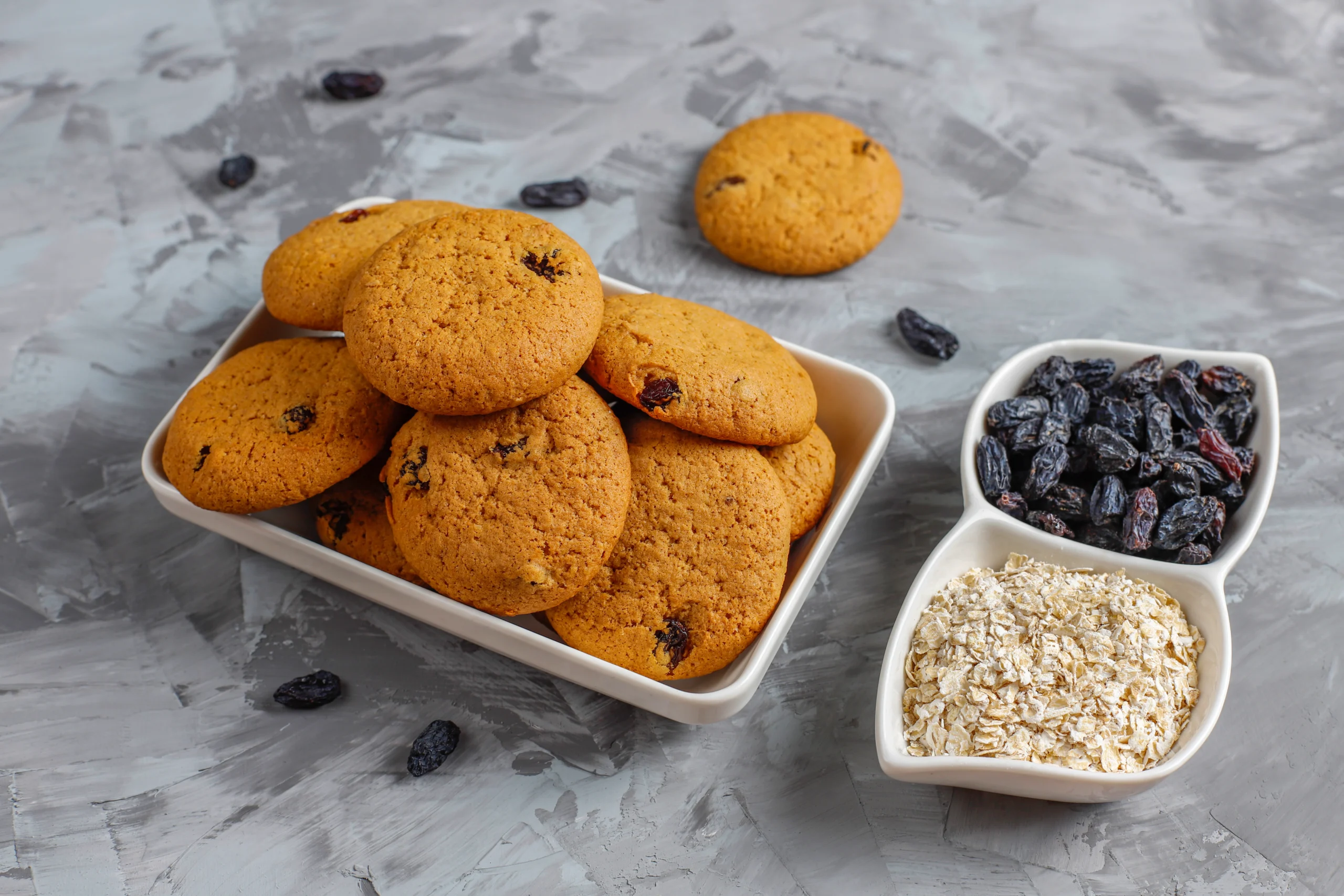
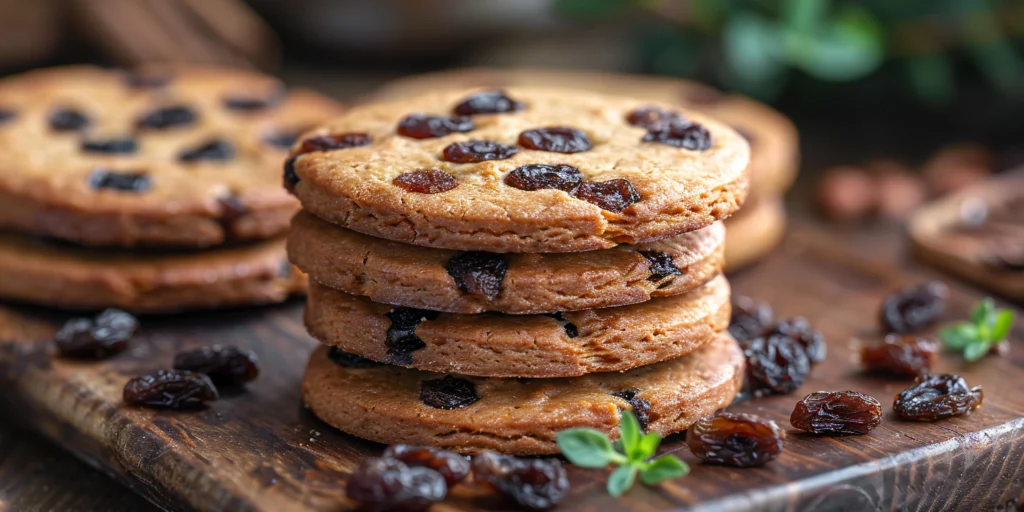
Color: Golden brown on the outside, often slightly paler inside.
Shape: Typically round, with a somewhat rough and uneven surface.
Size: Diameter can range from 2 to 4 inches (5-10 cm), depending on the recipe.
Texture: Soft and chewy, especially when fresh. The oats provide a hearty texture, and the raisins add moisture and chewiness.
Culinary Uses
Common Dishes: Eaten as a snack or dessert. Sometimes crumbled to use as a topping for yogurt or ice cream.
Preparation Methods: Baked from a dough made with oats, flour, sugar (both brown and white), butter or oil, eggs, raisins, and often cinnamon and vanilla for flavoring.
Suitable Pairings: Often paired with milk or coffee. Also complements the flavors of nuts (such as walnuts or pecans) when included in the recipe.
Geographical Information
Origin: The concept of oatmeal cookies dates back to Scotland, with raisins being a common addition in various cultures.
Primary Growing Regions: As a baked good, its production is not limited by region, though oats and raisins have their own specific growing areas. Oats are widely cultivated in temperate zones, including Canada, Poland, and Russia. Raisins are produced in regions with a lot of sun and dry weather, like California in the USA and parts of the Mediterranean.
Seasonal Availability: Oatmeal raisin cookies can be made year-round as their primary ingredients (oats and raisins) are shelf-stable.
This overview provides a general idea of oatmeal raisin cookies, covering their nutritional content, physical characteristics, culinary uses, and geographical information. Specific details can vary significantly depending on individual recipes and preparation methods.
| Proximates: | |
| Water | 8.85 g |
| Energy (Atwater General Factors) | 430 kcal |
| Nitrogen | 0.93 g |
| Protein | 5.79 g |
| Total lipid (fat) | 14.3 g |
| Total fat (NLEA) | 13.7 g |
| Ash | 1.44 g |
| Carbohydrates: | |
| Carbohydrate, by difference | 69.6 g |
| Carbohydrate, by summation | 67.9 g |
| Fiber, total dietary | 3.3 g |
| Sugars, Total | 34.8 g |
| Sucrose | 15.1 g |
| Glucose | 7.58 g |
| Fructose | 11.1 g |
| Maltose | 1.01 g |
| Starch | 29.8 g |
| Minerals: | |
| Calcium, Ca | 29 mg |
| Iron, Fe | 2.28 mg |
| Magnesium, Mg | 32.4 mg |
| Phosphorus, P | 111 mg |
| Potassium, K | 245 mg |
| Sodium, Na | 314 mg |
| Zinc, Zn | 0.62 mg |
| Copper, Cu | 0.141 mg |
| Manganese, Mn | 0.755 mg |
| Selenium, Se | 6 µg |
| Vitamins and Other Components: | |
| Thiamin | 0.295 mg |
| Riboflavin | 0.218 mg |
| Niacin | 2.11 mg |
| Pantothenic acid | 0.4 mg |
| Vitamin B-6 | 0.07 mg |
| Folate, total | 34 |
| Vitamin E (alpha-tocopherol) | 2.69 mg |
| Tocopherol, beta | 0.22 mg |
| Tocopherol, gamma | 5.27 mg |
| Tocopherol, delta | 2.4 mg |
| Tocotrienol, alpha | 0.8 mg |
| Tocotrienol, beta | 0.38 mg |
| Tocotrienol, gamma | 0.51 mg |
| Vitamin K (phylloquinone) | 17.1 µg |
| Lipids: | |
| Fatty acids, total saturated | 4.78 g |
| SFA 4:0 | 0.011 g |
| SFA 8:0 | 0.014 g |
| SFA 10:0 | 0.011 g |
| SFA 12:0 | 0.074 g |
| SFA 14:0 | 0.064 g |
| SFA 15:0 | 0.005 g |
| SFA 16:0 | 2.23 g |
| SFA 17:0 | 0.014 g |
| SFA 18:0 | 2.25 g |
| SFA 20:0 | 0.048 g |
| SFA 22:0 | 0.038 g |
| SFA 24:0 | 0.016 g |
| Fatty acids, total monounsaturated | 4 g |
| MUFA 16:1 c | 0.019 g |
| MUFA 17:1 | 0.005 g |
| MUFA 17:1 c | 0.005 g |
| MUFA 18:1 c | 3.9 g |
| MUFA 20:1 c | 0.068 g |
| MUFA 22:1 c | 0.004 g |
| MUFA 22:1 n-9 | 0.004 g |
| MUFA 24:1 c | 0.003 g |
| Fatty acids, total polyunsaturated | 4.89 g |
| PUFA 18:2 c | 4.22 g |
| PUFA 18:2 n-6 c,c | 4.21 g |
| PUFA 18:2 CLAs | 0.006 g |
| PUFA 18:3 c | 0.657 g |
| PUFA 18:3 n-3 c,c,c (ALA) | 0.632 g |
| PUFA 18:3 n-6 c,c,c | 0.025 g |
| PUFA 20:2 c | 0.004 g |
| PUFA 20:2 n-6 c,c | 0.004 g |
| PUFA 20:4 | 0.007 g |
| PUFA 20:4c | 0.007 g |
| PUFA 20:5c | 0.004 g |
| PUFA 20:5 n-3 (EPA) | 0.004 g |
| PUFA 22:6 c | 0.001 g |
| PUFA 22:6 n-3 (DHA) | 0.001 g |
| Fatty acids, total trans | 0.04 g |
| Fatty acids, total trans-monoenoic | 0.02 g |
| Fatty acids, total trans-dienoic | 0.02 g |
| TFA 18:2 t not further defined | 0.02 g |