
Basic Information
- Common Name: Pollock
- Scientific Name: Pollachius virens (Atlantic Pollock) and Gadus chalcogrammus (Alaska Pollock)
- Category: Seafood (Fish)
Varieties
Pollock is primarily divided into two main species:
- Atlantic Pollock: Often considered the true pollock, it is found in colder waters of the Atlantic.
- Alaska Pollock: A major source for the seafood industry, especially for processed products, found in the northern Pacific Ocean.
Nutritional Information
- Macronutrients:
- Carbohydrates: Pollock contains no carbohydrates.
- Proteins: High in protein, offering about 19g of protein per 100g serving.
- Fats: Low in fat, with about 1g per 100g serving. Contains omega-3 fatty acids, beneficial for heart and brain health.
- Micronutrients:
- Vitamins: Good source of B-vitamins, including B12, B6, and niacin (B3), which are essential for energy metabolism and neurological health.
- Minerals: Rich in selenium, phosphorus, and potassium. It also provides a decent amount of magnesium and calcium.
Phytonutrients
Fish, including raw pollock, do not contain phytonutrients in the way plants do, because phytonutrients are specific to plant-based foods. However, pollock and other fish are excellent sources of various bioactive compounds and nutrients that offer significant health benefits, similar to the role phytonutrients play in plant foods. For pollock, these include:
Omega-3 Fatty Acids
- EPA (Eicosapentaenoic Acid) and DHA (Docosahexaenoic Acid): Essential for cardiovascular health, brain function, and reducing inflammation. While not classified as phytonutrients, omega-3 fatty acids offer comparable health benefits, such as reducing the risk of chronic diseases.
Proteins and Amino Acids
- High-quality, complete proteins that contain all the essential amino acids necessary for human health. These proteins are crucial for building and repairing tissues, making enzymes and hormones, and supporting overall growth and development.
Vitamins
- Vitamin D: Important for bone health by helping the body absorb calcium; also plays a role in immune function and inflammation reduction.
- Vitamin B12: Crucial for the formation of red blood cells, neurological function, and DNA synthesis.
- Niacin (Vitamin B3): Supports metabolism and is important for the nervous system, digestive system, and skin health.
Minerals
- Selenium: A powerful antioxidant that helps protect the body from oxidative stress and supports a healthy immune system.
- Iodine: Essential for thyroid gland function, which regulates metabolic processes.
- Phosphorus: Important for the formation of bones and teeth and plays a key role in how the body uses carbohydrates and fats.
Others
- Astaxanthin (in some fish species): A type of carotenoid that gives salmon and some shellfish their pink or red coloration. It has strong antioxidant properties, although it’s less commonly found in pollock.
While pollock may not contain phytonutrients, the nutrients it does provide are essential for maintaining health and preventing disease. Including pollock and other fish in your diet can contribute to a balanced intake of essential fatty acids, proteins, vitamins, and minerals.
Calorie Count and Glycemic Index
- Calorie Count: A 100g serving of raw pollock contains approximately 92 calories.
- Glycemic Index: Being a protein-rich food without carbohydrates, pollock has a glycemic index (GI) of 0.
Physical Characteristics
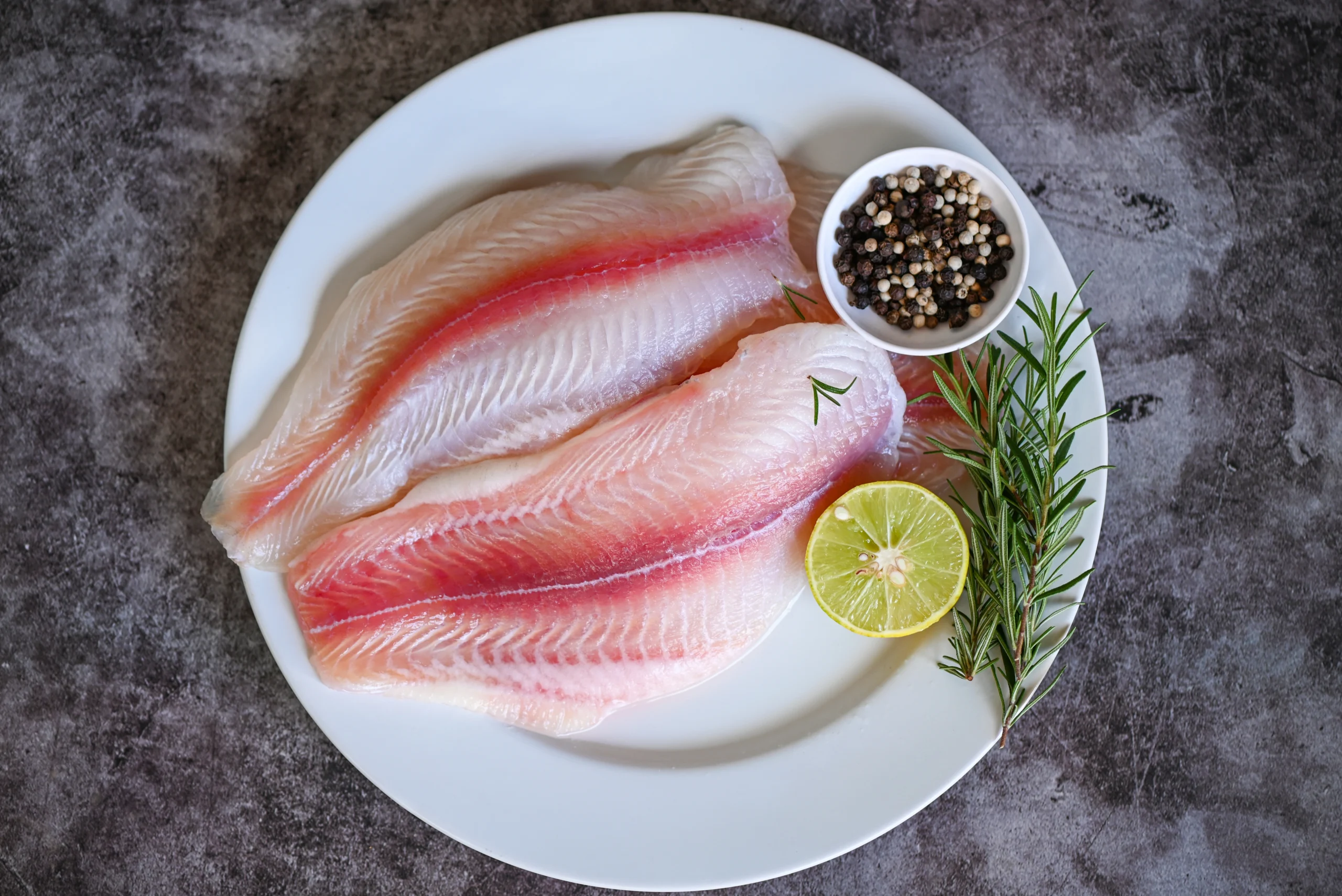
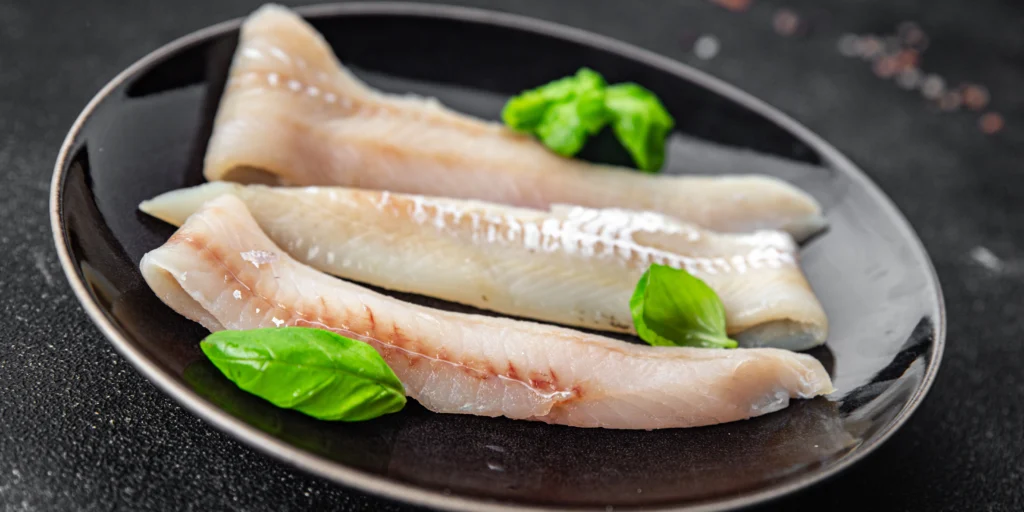
- Color: Raw pollock flesh is white and becomes opaque when cooked.
- Shape: Pollock has an elongated body with a slightly round cross-section.
- Size: Can grow up to about 3.5 feet (1 meter) in length, but commonly found smaller in markets.
- Texture: The flesh is firm with a moist feel, known for being flaky and tender once cooked.
Culinary Uses
- Common Dishes: Pollock is widely used in fish sticks, imitation crab meat (surimi), and is often battered and fried for fish and chips. It’s also popular in stews and soups.
- Preparation Methods: Can be baked, broiled, grilled, poached, or fried. Its mild flavor makes it versatile for various cooking methods.
- Suitable Pairings: Pairs well with a broad range of flavors, including lemon, garlic, herbs, and butter. It complements sides like potatoes, rice, and vegetables.
Geographical Information
- Origin: Pollock is native to the North Atlantic Ocean (Atlantic Pollock) and the northern Pacific Ocean (Alaska Pollock).
- Primary Growing Regions: Atlantic Pollock is primarily harvested in the cold waters off the coast of New England and Canada. Alaska Pollock is most abundant in the Bering Sea.
- Seasonal Availability: Available year-round due to sustainable fishing practices and the large biomass of Alaska Pollock.
Pollock stands out for its nutritional benefits, especially as a low-calorie, high-protein option with beneficial omega-3 fatty acids. Its versatility in the kitchen and the role it plays in various processed seafood products make it a staple in many diets worldwide. Its sustainable status also makes it an environmentally friendly seafood choice.
| proximates: | |
| Water | 86.7 g |
| Energy (Atwater General Factors) | 53 kcal |
| Energy (Atwater Specific Factors) | 56 kcal |
| Nitrogen | 1.97 g |
| Protein | 12.3 g |
| Total lipid (fat) | 0.41 g |
| Total fat (NLEA) | 0.4 g |
| Ash | 1.36 g |
| Carbohydrates: | |
| Carbohydrate, by difference | 0 g |
| Minerals: | |
| Calcium, Ca | 15 mg |
| Iron, Fe | 0.22 mg |
| Magnesium, Mg | 16.1 mg |
| Phosphorus, P | 284 mg |
| Potassium, K | 160 mg |
| Sodium, Na | 333 mg |
| Zinc, Zn | 0.31 mg |
| Copper, Cu | 0.031 mg |
| Manganese, Mn | 0.011 mg |
| Selenium, Se | 15.9 µg |
| Vitamins and Other Components: | |
| Vitamin C, total ascorbic acid | 0 mg |
| Thiamin | 0.03 mg |
| Riboflavin | 0.08 mg |
| Niacin | 0.653 mg |
| Pantothenic acid | 0.237 mg |
| Vitamin B-6 | 0.069 mg |
| Vitamin B-12 | 1.63 µg |
| Vitamin A, RAE | 3 µg |
| Retinol | 3 µg |
| Vitamin E (alpha-tocopherol) | 0.49 mg |
| Tocopherol, beta | 0 mg |
| Tocopherol, gamma | 0 mg |
| Tocopherol, delta | 0 mg |
| Tocotrienol, alpha | 0 mg |
| Tocotrienol, beta | 0 mg |
| Tocotrienol, gamma | 0 mg |
| Tocotrienol, delta | 0 mg |
| Vitamin D (D2 + D3), International Units | 8 IU |
| Vitamin D (D2 + D3) | 0.2 µg |
| Vitamin D3 (cholecalciferol) | 0.2 µg |
| Vitamin K (phylloquinone) | 0 µg |
| Vitamin K (Dihydrophylloquinone) | 0 µg |
| Vitamin K (Menaquinone-4) | 0 µg |
| Lipids: | |
| Fatty acids, total saturated | 0.128 g |
| SFA 4:0 | 0.002 g |
| SFA 6:0 | 0 g |
| SFA 8:0 | 0 g |
| SFA 10:0 | 0.002 g |
| SFA 11:0 | 0 g |
| SFA 12:0 | 0.001 g |
| SFA 14:0 | 0.004 g |
| SFA 15:0 | 0.001 g |
| SFA 16:0 | 0.087 g |
| SFA 17:0 | 0.001 g |
| SFA 18:0 | 0.028 g |
| SFA 20:0 | 0 g |
| SFA 22:0 | 0 g |
| SFA 24:0 | 0 g |
| Fatty acids, total monounsaturated | 0.073 g |
| MUFA 14:1 c | 0.001 g |
| MUFA 15:1 | 0.001 g |
| MUFA 16:1 c | 0.003 g |
| MUFA 17:1 | 0.004 g |
| MUFA 17:1 c | 0.004 g |
| MUFA 18:1 c | 0.048 g |
| MUFA 20:1 | 0.01 g |
| MUFA 20:1 c | 0.01 g |
| MUFA 22:1 c | 0.001 g |
| MUFA 24:1 c | 0.005 g |
| Fatty acids, total polyunsaturated | 0.182 g |
| PUFA 18:2 c | 0.005 g |
| PUFA 18:2 n-6 c,c | 0.004 g |
| PUFA 18:2 CLAs | 0 g |
| PUFA 18:3 c | 0.001 g |
| PUFA 18:3 n-3 c,c,c (ALA) | 0.001 g |
| PUFA 18:3 n-6 c,c,c | 0 g |
| PUFA 18:4 | 0.001 g |
| PUFA 20:2 c | 0.001 g |
| PUFA 20:2 n-6 c,c | 0.001 g |
| PUFA 20:3 c | 0.002 g |
| PUFA 20:3 n-3 | 0 g |
| PUFA 20:3 n-6 | 0.002 g |
| PUFA 20:4 | 0.005 g |
| PUFA 20:4c | 0.005 g |
| PUFA 20:5c | 0.049 g |
| PUFA 20:5 n-3 (EPA) | 0.049 g |
| PUFA 22:2 | 0 g |
| PUFA 22:5 c | 0.004 g |
| PUFA 22:4 | 0 g |
| PUFA 22:5 n-3 (DPA | 0.004 g |
| PUFA 22:6 c | 0.116 g |
| PUFA 22:6 n-3 (DHA) | 0.116 g |
| Fatty acids, total trans | 0.016 g |
| Fatty acids, total trans-monoenoic | 0.004 g |
| TFA 16:1 t | 0 g |
| TFA 18:1 t | 0.004 g |
| TFA 22:1 t | 0 g |
| Fatty acids, total trans-dienoic | 0.011 g |
| TFA 18:2 t not further defined | 0.011 g |
| Cholesterol | 46 mg |
| Amino acids: | |
| Tryptophan | 0.18 g |
| Threonine | 0.58 g |
| Isoleucine | 0.62 g |
| Leucine | 1.06 g |
| Lysine | 1.21 g |
| Methionine | 0.4 g |
| Cystine | 0.14 g |
| Phenylalanine | 0.51 g |
| Tyrosine | 0.49 g |
| Valine | 0.67 8 |
| Arginine | 0.93 g |
| Histidine | 0.28 g |
| Alanine | 0.75 g |
| Aspartic acid | 1.31 g |
| Glutamic acid | 2.08 g |
| Glycine | 0.59 g |
| Proline | 0.5 g |
| Serine | 0.54 g |