


Basic Information
- Name: Ham, Sliced (Restaurant-Quality)
- Scientific Name: N/A (Processed food product made from Sus scrofa domesticus, domestic pig)
- Category: Processed meat
Varieties
Restaurant-quality sliced ham can vary based on the cut (e.g., Virginia ham, honey ham, smoked ham) and preparation methods (e.g., cured, smoked).
Nutritional Information
- Macronutrients:
- Carbohydrates: Generally low, around 2.36 g per 100 g, depending on added ingredients like honey or glazes.
- Proteins: Approximately 19.6 g per 100 g, a good source of high-quality protein.
- Fats: Can vary widely, from 3.68 g per 100 g, depending on the cut and preparation.
- Micronutrients: Source of B vitamins (B1, B2, B3, B6, B12), providing energy and supporting cell health. Contains minerals like iron, zinc, potassium, and phosphorus.
phytonutrients
Sliced ham served in restaurants, similar to pre-packaged deli meats, is primarily a processed meat product and does not contain phytonutrients in the way fruits, vegetables, and other plant-based foods do. Phytonutrients are naturally occurring compounds in plants that have health-promoting properties, including antioxidant, anti-inflammatory, and anti-carcinogenic effects. Since ham is an animal-based product, its nutritional profile is focused on macronutrients (proteins and fats), micronutrients (vitamins and minerals), but not phytonutrients.
Nutritional Components in Restaurant-Quality Sliced Ham:
While not phytonutrients, here are some key nutritional components typically found in ham:
- Proteins: High-quality proteins that are essential for muscle repair, growth, and overall body functions.
- B Vitamins: Particularly rich in B1 (thiamine), B2 (riboflavin), B3 (niacin), B6, and B12, which play vital roles in energy production and neurological health.
- Minerals: Provides minerals such as iron, which is crucial for forming red blood cells; zinc, important for immune function; and phosphorus, which is necessary for bone health.
- Fats: Although restaurant-quality sliced ham can be leaner depending on the cut and preparation, it still contains fats, which are important for nutrient absorption and cell health.
Health Considerations:
Consuming processed meats like ham should be done in moderation due to:
- Sodium Content: Ham, especially when cured or smoked, can be high in sodium, which may affect blood pressure and cardiovascular health.
- Additives: Processed meats can contain additives like nitrates and nitrites, which have been linked to health concerns, although their actual impact is subject to ongoing research and debate.
In summary, while restaurant-quality sliced ham does not contain phytonutrients, it can be a source of several important nutrients, including protein and vitamins. For those looking to incorporate phytonutrients into their diet, it’s recommended to consume a variety of fruits, vegetables, whole grains, and nuts alongside moderate consumption of animal products.
Calorie Count and Glycemic Index
- Calorie Count: Roughly 126 calories per 100 g, depending on the fat content and preparation.
- Glycemic Index: Not applicable (minimal carbohydrate content).
Physical Characteristics
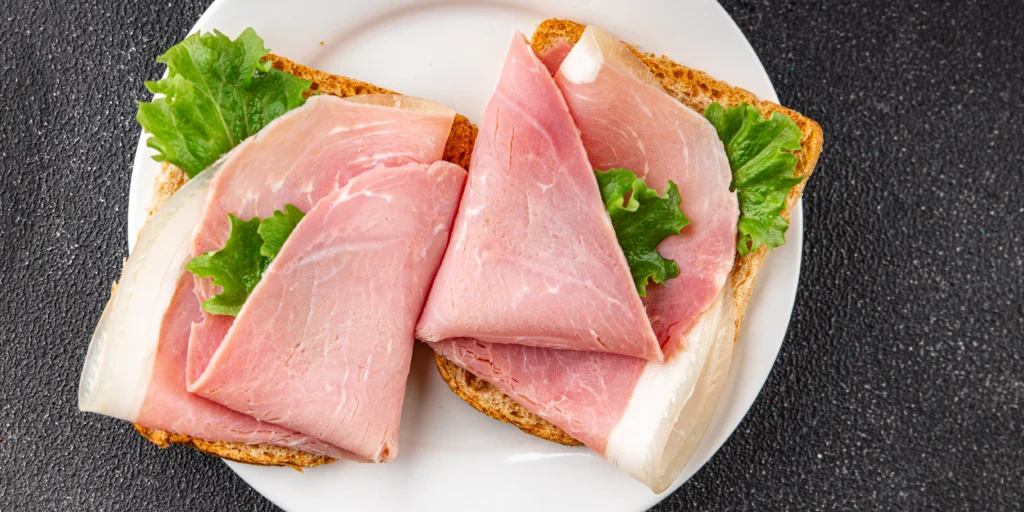
- Color: Pink to light red, typical of cured ham.
- Shape: Thinly sliced, often in round or rectangular shapes based on the cut.
- Size: Slices vary in size but are typically 1-3 mm thick.
- Texture: Tender and moist, with a smooth or slightly textured surface depending on the preparation (e.g., smoked).
Culinary Uses
Restaurant-quality sliced ham is versatile and can be featured in various dishes:
- Common Dishes: Used in sandwiches, salads, breakfast plates (e.g., Eggs Benedict), and as a topping for pizzas or incorporated into pasta dishes.
- Preparation Methods: Often served as is, but can be grilled, fried, or baked for added flavor in hot dishes.
- Suitable Pairings: Pairs well with cheeses (e.g., Swiss, cheddar), fruits (e.g., pineapple, melon), and used in combination with other breakfast foods like eggs and pancakes.
Geographical Information
- Origin: The practice of curing ham dates back to ancient times, with techniques evolving in Europe and America.
- Primary Growing Regions: Pork, the primary ingredient for ham, is produced globally, with major producers including China, the EU, and the United States.
- Seasonal Availability: Available year-round, given the preserved nature of ham.
Sliced ham served in restaurants often has a higher quality and may come from specific premium cuts of pork, offering a richer flavor and texture compared to some pre-packaged options. Its nutritional profile can provide valuable protein and micronutrients, although attention should be paid to its sodium and fat content, especially in diets where these are a concern.
| proximates: | |
| Water | 70.7 g |
| Energy (Atwater General Factors) | 121 kcal |
| Energy (Atwater Specific Factors) | 126 kcal |
| Nitrogen | 3.14 g |
| Protein | 19.6 g |
| Total lipid (fat) | 3.68 g |
| Total fat (NLEA) | 3.54 g |
| Ash | 3.63 g |
| Carbohydrates: | |
| Carbohydrate, by difference | 2.36 g |
| Sugars, Total | 2.2 g |
| Sucrose | 0.4 g |
| Glucose | 1.8 g |
| Minerals: | |
| Calcium, Ca | 6 mg |
| Iron, Fe | 0.86 mg |
| Magnesium, Mg | 20.3 mg |
| Phosphorus, P | 2.46 mg |
| Potassium, K | 484 mg |
| Sodium, Na | 1030 mg |
| Zinc, Zn | 1.76 mg |
| Copper, Cu | 0.041 mg |
| Manganese, Mn | 0.015 mg |
| Lipids: | |
| Fatty acids, total saturated | 1.25 g |
| SFA 8:0 | 0.001 g |
| SFA 10:0 | 0.004 g |
| SFA 12:0 | 0.003 g |
| SFA 14:0 | 0.043 g |
| SFA 15:0 | 0.002 g |
| SFA 16:0 | 0.733 g |
| SFA 17:0 | 0.008 g |
| SFA 18:0 | 0.367 g |
| SFA 20:0 | 0.005 g |
| SFA 22:0 | 0.002 g |
| Fatty acids, total monounsaturated | 1.6 g |
| MUFA 14:1 c | 0.001 g |
| MUFA 16:1 c | 0.086 g |
| MUFA 17:1 | 0.007 g |
| MUFA 17:1 c | 0.007 g |
| MUFA 18:1 c | 1.38 g |
| MUFA 20:1 c | 0.023 g |
| Fatty acids, total polyunsaturated | 0.675 g |
| PUFA 18:2 c | 0.479 g |
| PUFA 18:2 n-6 c,c | 0.477 g |
| PUFA 18:2 CLAs | 0.002 g |
| PUFA 18:3 c | 0.018 g |
| PUFA 18:3 n-3 c,c,c (ALA) | 0.016 g |
| PUFA 18:3 n-6 c,c,c | 0.002 g |
| PUFA 20:2 c | 0.017 g |
| PUFA 20:2 n-6 c,c | 0.017 g |
| PUFA 20:3 c | 0.011 g |
| PUFA 20:3 n-3 | 0.003 g |
| PUFA 20:3 n-6 | 0.008 g |
| PUFA 20:4 | 0.059 g |
| PUFA 20:4c | 0.059 g |
| PUFA 20:5c | 0.001 g |
| PUFA 20:5 n-3 (EPA) | 0.001 g |
| PUFA 22:5 c | 0.006 g |
| PUFA 22:4 | 0.01 g |
| PUFA 22:5 n-3 (DPA) | 0.006 g |
| PUFA 22:6 c | 0.001 g |
| PUFA 22:6 n-3 (DHA) | 0.001 g |
| Fatty acids, total trans | 0.017 g |
| Fatty acids, total trans-monoenoic | 0.01 g |
| TFA 18:1 t | 0.009 g |
| Fatty acids, total trans-dienoic | 0.001 g |
| TFA 18:2 t not further defined | 0.001 g |