


Basic Information
- Name: Iceberg Lettuce
- Scientific Name: Lactuca sativa
- Category: Vegetable
Varieties
Iceberg lettuce is a specific variety of lettuce known for its crisp texture and mild flavor. It doesn’t have sub-varieties like some other vegetables but is distinct from other types of lettuce such as romaine, butterhead, and leaf lettuces.
Nutritional Information
- Macronutrients:
- Carbohydrates: Approximately 3.37 g per 100 g, primarily from sugars and dietary fiber.
- Proteins: About 0.74 g per 100 g.
- Fats: Negligible, about 0.07 g per 100 g.
- Micronutrients: Contains small amounts of Vitamin C, Vitamin K, and folate. Also provides minerals like potassium and calcium, but in lower quantities compared to other leafy greens.
phytonutrients
Iceberg lettuce, while not as nutrient-dense as some darker leafy greens, still contains a variety of phytonutrients that contribute to its health benefits. These bioactive compounds have roles in providing antioxidant protection and supporting overall health, albeit in lower quantities compared to other lettuce varieties or leafy greens like kale or spinach. Here’s an overview of the phytonutrients found in raw iceberg lettuce:
Types of Phytonutrients in Iceberg Lettuce
- Flavonoids: Iceberg lettuce contains flavonoids such as quercetin and kaempferol, though in smaller amounts compared to darker leafy greens. These compounds have antioxidant properties that can help protect cells from damage caused by free radicals.
- Lutein and Zeaxanthin: These carotenoids are present in iceberg lettuce and are known for their eye health benefits, particularly in protecting against cataracts and age-related macular degeneration.
- Beta-carotene: While iceberg lettuce has lower levels of beta-carotene than other green vegetables, it still provides this important antioxidant, which the body can convert into vitamin A, supporting immune function, vision, and skin health.
Nutritional Implications
The phytonutrients in iceberg lettuce offer various health benefits:
- Antioxidant Support: The antioxidants present, including flavonoids and carotenoids, help neutralize free radicals, potentially reducing the risk of chronic diseases associated with oxidative stress.
- Eye Health: The carotenoids lutein and zeaxanthin contribute to protecting the eyes from harmful light and oxidative damage, supporting overall eye health.
While iceberg lettuce is not the most nutrient-dense option among leafy greens, it still contributes valuable phytonutrients to the diet. Its high water content also makes it a hydrating choice, particularly beneficial in salads, sandwiches, and as a low-calorie snack. To maximize the intake of phytonutrients and other essential nutrients, it’s beneficial to include a variety of fruits and vegetables in your diet, combining iceberg lettuce with darker, more nutrient-rich leafy greens.
Calorie Count and Glycemic Index
- Calorie Count: Roughly 14 calories per 100 g.
- Glycemic Index: Low (since it’s low in carbohydrates).
Physical Characteristics
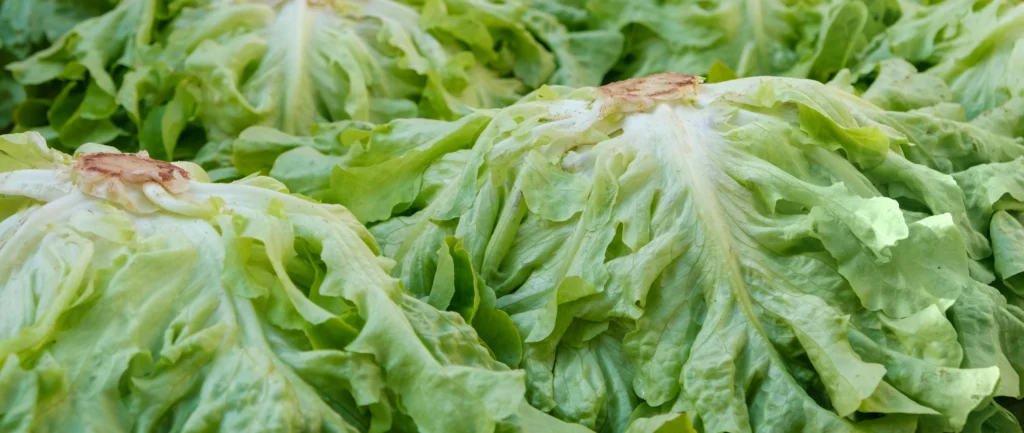
- Color: Pale green outer leaves with a whiter interior.
- Shape: Forms a tight, round head similar to cabbage.
- Size: Heads can range from slightly larger than a softball to about the size of a soccer ball.
- Texture: Crunchy and watery, with a very mild flavor.
Culinary Uses
Iceberg lettuce is commonly used in:
- Common Dishes: Salads, sandwiches, wraps, and as a garnish. Also used as a bed for serving other foods.
- Preparation Methods: Typically eaten raw. The leaves can be torn or chopped for salads or used whole in sandwiches and burgers.
- Suitable Pairings: Its mild taste and crunchy texture pair well with a wide range of dressings, vegetables, and proteins, making it versatile in use.
Geographical Information
- Origin: Iceberg lettuce is believed to have originated in the United States in the late 19th century.
- Primary Growing Regions: Widely cultivated in temperate regions around the world. Major producers include the United States (particularly California and Arizona), Mexico, and parts of Europe.
- Seasonal Availability: Available year-round due to its cultivation in various climates.
Iceberg lettuce is favored for its crunchy texture and ability to stay fresh longer than many other types of lettuce. While it’s lower in vitamins and minerals than darker green leafy vegetables, it still provides hydration and some essential nutrients, making it a crisp, refreshing addition to various dishes.
| proximates: | |
| Water | 95.5 g |
| Energy (Atwater General Factors) | 17 kcal |
| Energy (Atwater Specific Factors) | 14 kcal |
| Nitrogen | 0.12 g |
| Protein | 0.74 g |
| Total lipid (fat) | 0.07 |
| Ash | 0.32 g |
| Carbohydrates: | |
| Carbohydrate, by difference | 3.37 g |
| Minerals: | |
| Calcium, Ca | 14 mg |
| Iron, Fe | 0.03 mg |
| Magnesium, Mg | 6.3 mg |
| Phosphorus, P | 19 mg |
| Potassium, K | 139 mg |
| Sodium, Na | 16 mg |
| Zinc, Zn | 0.17 mg |
| Copper, Cu | 0.033 mg |
| Manganese, Mn | 0.082 mg |
| Vitamins and Other Components: | |
| Thiamin | 0.056 mg |
| Niacin | 0.218 mg |
| Vitamin B-6 | 0.04 mg |
| Vitamin K (phylloquinone) | 20.5 µg |
| Vitamin K (Dihydrophylloquinone) | <0.1 µg |
| Vitamin K (Menaquinone-4) | <0.1 µg |