

Basic Information
- Common Name: Almonds
- Scientific Name: Prunus dulcis
- Category: Nut
Varieties
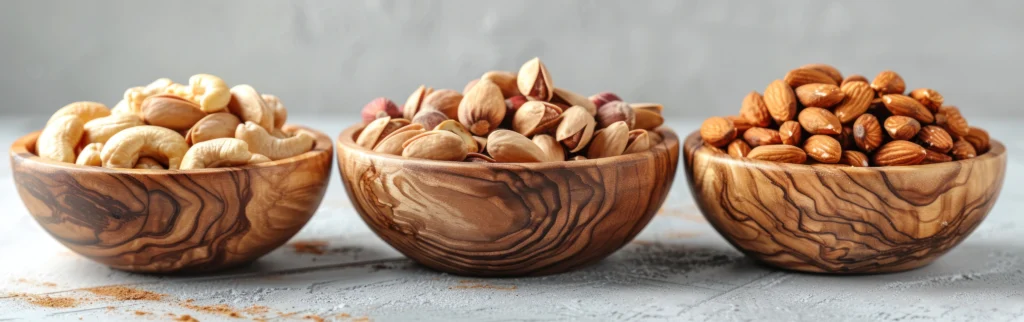
Almonds can be classified into two main types based on their use: sweet almonds (Prunus dulcis var. dulcis), which are commonly eaten and used in a variety of culinary applications, and bitter almonds (Prunus dulcis var. amara), which are used in making almond oil and are not typically consumed raw due to their toxicity when raw. Sweet almonds come in many forms, including whole raw, blanched, slivered, and roasted.
Nutritional Information
Macronutrients (per 100g of whole, raw almonds)
- Carbohydrates: Approximately 20g
- Proteins: About 21.4g
- Fats: 51.1g
Micronutrients
Whole, raw almonds are a rich source of vitamins and minerals, notably:
- Vitamins: Vitamin E, riboflavin (B2), and niacin (B3).
- Minerals: Magnesium, phosphorus, potassium, calcium, iron, and zinc.
Phytonutrients
Whole, raw almonds are not only nutrient-dense with essential vitamins and minerals, but they also contain a variety of beneficial phytonutrients. These compounds contribute to the health benefits of almonds, including antioxidant properties, heart health support, and potential roles in reducing the risk of chronic diseases. Here are some key phytonutrients found in raw almonds:
Phenolic Acids
- Hydroxybenzoic acids and Hydroxycinnamic acids: These compounds are part of a broader group of polyphenols known for their antioxidant properties, which help protect the body from oxidative stress and reduce inflammation.
Flavonoids
- Flavan-3-ols (such as catechins): Present in almonds, catechins are antioxidants that can improve heart health and aid in preventing certain diseases.
- Flavonols (such as quercetin): Known for their anti-inflammatory and antioxidant effects, flavonols in almonds can contribute to reducing the risk of various health conditions.
- Isoflavones: While less prominent in almonds than in soy-based products, isoflavones have been studied for their potential role in reducing the risk of heart disease and certain cancers.
Tannins
- Condensed tannins (proanthocyanidins): These compounds have strong antioxidant properties and may help reduce the risk of chronic diseases.
Phytosterols
- Beta-sitosterol: This is one of the most common phytosterols in almonds. Phytosterols are known for their ability to lower LDL (bad) cholesterol levels, contributing to heart health.
Nitriles
- Amygdalin (in trace amounts): While more associated with bitter almonds, sweet almonds (the variety typically consumed) can contain trace amounts of amygdalin, which is a compound that can release cyanide when metabolized. However, the levels in sweet almonds are generally considered safe for consumption.
Other Compounds
- Fiber: Although not a phytonutrient, the dietary fiber in almonds contributes significantly to digestive health, helps manage blood sugar levels, and supports weight management by promoting a feeling of fullness.
- Vitamin E (Tocopherols and Tocotrienols): As a powerful antioxidant, vitamin E in almonds helps protect cells from oxidative damage.
Almonds’ unique combination of phytonutrients contributes to their wide array of health benefits. Consuming almonds as part of a balanced diet can help improve cardiovascular health, support weight management, and decrease the risk of chronic diseases. However, it’s essential to consume them in moderation due to their high calorie and fat content.
Calorie Count
Raw almonds contain about 584 calories per 100 grams.
Glycemic Index
Almonds have a low glycemic index (GI), typically estimated at 0 to 5, making them an excellent food choice for blood sugar management.
Physical Characteristics
- Color: Light brown skin, with the kernel itself being a creamy white.
- Shape: Oblong and slightly pointed at one end, with a convex curve on one side and a flatter curve on the other.
- Size: Each almond is about 1 to 1.5 inches (2.5 to 3.8 cm) in length.
- Texture: Whole, raw almonds have a firm and crunchy texture, with a slightly oily feel due to their natural fat content.
Culinary Uses
Whole, raw almonds are highly versatile in the kitchen:
- Common Dishes: Eaten as a nutritious snack, added to salads, yogurts, and cereals, or used in baking and cooking for added texture and flavor.
- Preparation Methods: Can be soaked, blanched, or ground into almond flour for various culinary applications.
- Suitable Pairings: Complement fruits, chocolates, cheeses, and are integral to dishes in Mediterranean, Middle Eastern, and Indian cuisines.
Geographical Information
- Origin: Originally native to the Middle East, India, and North Africa.
- Primary Growing Regions: Today, California in the United States is the largest producer of almonds globally. Other significant almond-growing regions include Spain, Iran, Morocco, and Italy.
- Seasonal Availability: Almonds are typically harvested between August and October but are available year-round in their raw form due to their long shelf life and storage capabilities.
| proximates: | |
| Water | 4.26 g |
| Energy (Atwater General Factors) | 626 kcal |
| Energy (Atwater Specific Factors) | 584 kcal |
| Nitrogen | 4.14 g |
| Protein | 21.4 g |
| Total lipid (fat) | 51.1 g |
| Ash | 3.16 g |
| Carbohydrates: | |
| Carbohydrate, by difference | 20 g |
| Fiber, total dietary | 10.8 g |
| Minerals: | |
| Calcium, Ca | 254 mg |
| Iron, Fe | 3.74 mg |
| Magnesium, Mg | 258 mg |
| Phosphorus, P | 503 mg |
| Potassium, K | 733 mg |
| Sodium, Na | <2.5 mg |
| Zinc, Zn | 2.86 mg |
| Copper, Cu | 0.91 mg |
| Manganese, Mn | 2.15 mg |
| Molybdenum, Mo | 45.3 µg |
| Vitamins and Other Components: | |
| Thiamin | 0.16 mg |
| Niacin | 3.77 mg |
| Vitamin B-6 | 0.101 mg |
| Biotin | 57 µg |
| Vitamin K (phylloquinone) | <0.1 µg |
| Vitamin K (Dihydrophylloquinone) | <0.1 µg |
| Vitamin K (Menaquinone-4) | <0.1 µg |
| Lipids: | |
| Fatty acids, total saturated | 3.78 g |
| Fatty acids, total monounsaturated | 31.3 g |
| Fatty acids, total polyunsaturated | 11.2 g |
| Amino acids: | |
| Tryptophan | 0.208 g |
| Threonine | 0.608 g |
| Isoleucine | 0.774 g |
| Leucine | 1.49 g |
| Lysine | 0.618 g |
| Methionine | 0.154 g |
| Phenylalanine | 1.2 g |
| Tyrosine | 0.63 g |
| Valine | 0.916 g |
| Arginine | 2.46 g |
| Histidine | 0.548 g |
| Alanine | 0.98 g |
| Aspartic acid | 2.4 g |
| Glutamic acid | 4.25 g |
| Glycine | 1.43 g |
| Proline | 1.31 g |
| Serine | 0.99 g |
| Hydroxyproline | <0.01 g |
| Cysteine | 0.5 g |