

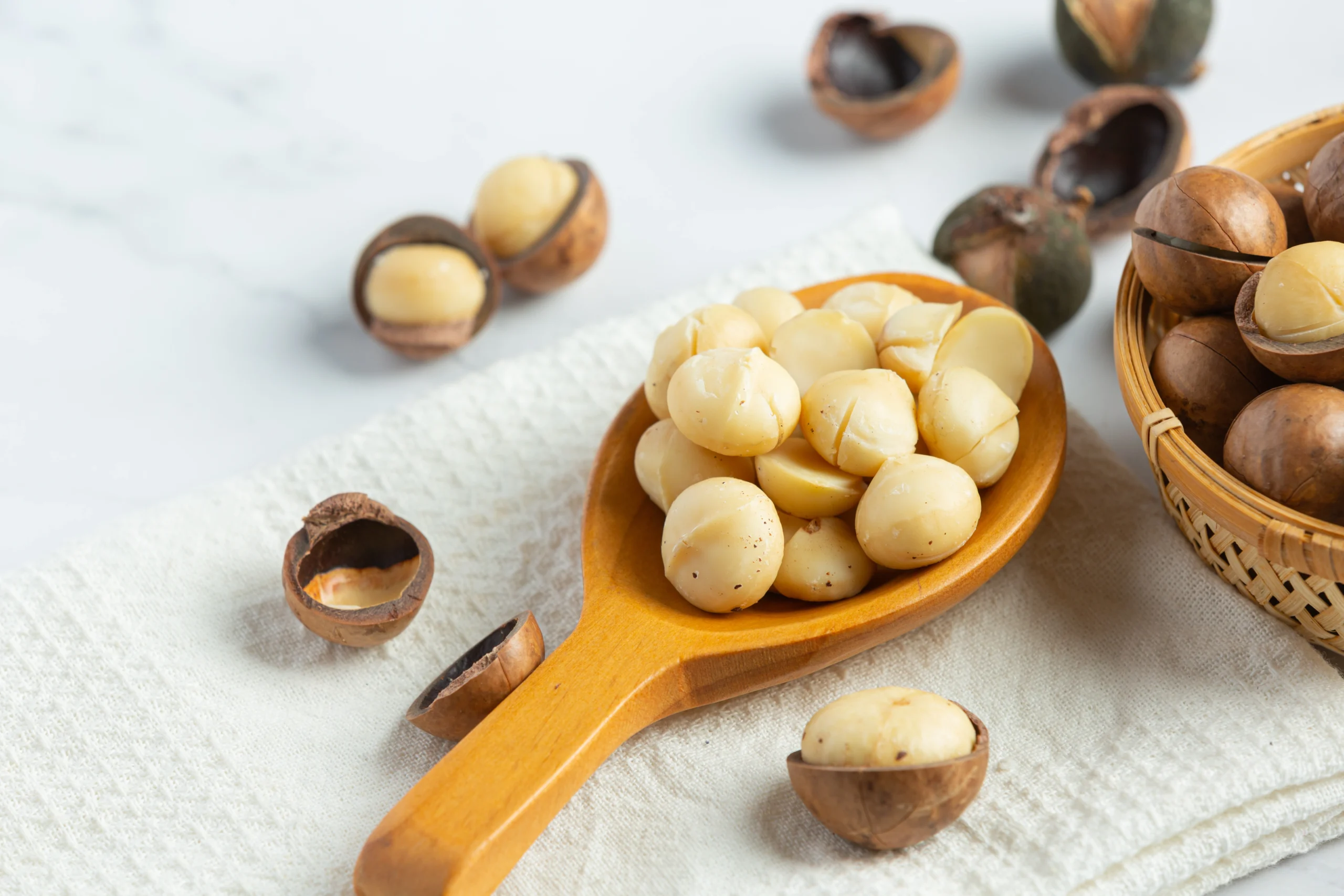
Basic Information
- Common Name: Macadamia Nuts
- Scientific Name: Macadamia integrifolia (smooth-shelled macadamia) and Macadamia tetraphylla (rough-shelled macadamia), among others.
- Category: Nut
Varieties
There are two primary species of macadamia nuts commercially cultivated:
- Macadamia integrifolia: Known for its smooth shell, it’s the most commonly cultivated species.
- Macadamia tetraphylla: Recognized by its rough shell.
Several hybrids and cultivars exist, developed for their yield, size, and taste characteristics.
Nutritional Information
Macronutrients (per 100g of raw macadamia nuts)
- Carbohydrates: Approximately 24.1g
- Proteins: About 7.79g
- Fats: 64.9g, making them one of the richest sources of dietary fats among nuts.
Micronutrients
Macadamia nuts are a good source of:
- Vitamins: Vitamin B1 (Thiamine) and some content of B6 and vitamin E.
- Minerals: Particularly rich in manganese and thiamine, with significant levels of magnesium, phosphorus, iron, and potassium.
Phytonutrients
Raw macadamia nuts, renowned for their rich, buttery flavor, are not only a delicious snack but also a source of beneficial phytonutrients. These compounds contribute to the nuts’ health benefits, which include antioxidant properties, heart health support, and potential roles in reducing inflammation and improving metabolic health. Here’s a look at the key phytonutrients found in raw macadamia nuts:
Antioxidants
- Tocotrienols and Tocopherols (Vitamin E variants): Macadamia nuts are a source of vitamin E, including both tocotrienols and tocopherols. These compounds act as powerful antioxidants, protecting cells from oxidative damage and potentially reducing the risk of chronic diseases.
Squalene
- Squalene: This unique compound is a potent antioxidant found in macadamia nuts. It’s known for its potential to improve skin health and protect against oxidative damage.
Phytosterols
- Beta-Sitosterol: Present in macadamia nuts, beta-sitosterol helps lower cholesterol levels by reducing intestinal cholesterol absorption. It contributes to cardiovascular health and may have anti-inflammatory effects.
Fatty Acids
- Monounsaturated Fats (primarily Oleic Acid): Macadamia nuts are high in monounsaturated fats, similar to those found in olive oil, which are known for their heart health benefits. These fats can help reduce LDL (bad) cholesterol levels while maintaining HDL (good) cholesterol levels.
- Palmitoleic Acid (Omega-7): Macadamia nuts are one of the few natural sources of palmitoleic acid, an omega-7 monounsaturated fatty acid, which may have beneficial effects on insulin sensitivity and inflammation.
Flavonoids
- Flavonoids: While not as prominent as in some other nuts, macadamia nuts do contain flavonoids, which are known for their antioxidant and anti-inflammatory properties. They can help neutralize free radicals and may contribute to reducing the risk of certain diseases.
Minerals with Antioxidant Properties
- Manganese: An essential mineral for bone health and metabolism, manganese also acts as a cofactor for the antioxidant enzyme superoxide dismutase (SOD), which helps mitigate oxidative stress in the body.

Dietary Fiber
- Fiber: Although not a phytonutrient, the dietary fiber in macadamia nuts supports digestive health, helps control blood sugar levels, and contributes to satiety, which may aid in weight management.
The phytonutrient profile of macadamia nuts underscores their potential health benefits, particularly for heart health and metabolic functions. However, due to their high calorie and fat content, it’s important to consume them in moderation as part of a balanced diet.
Calorie Count
Raw macadamia nuts contain about 712 calories per 100 grams.
Glycemic Index
Macadamia nuts have a very low glycemic index (GI), contributing positively to blood sugar management.
Physical Characteristics
- Color: The kernel is creamy white.
- Shape: Round to oblong and somewhat spherical.
- Size: Typically, each nut is about 1 inch (2.5 cm) in diameter.
- Texture: They have a hard, brown outer shell. The kernel itself is smooth, rich, and buttery.
Culinary Uses
Macadamia nuts are highly valued in the culinary world:
- Common Dishes: Used in baked goods, chocolates, and confections. They are also a popular ingredient in salads and savory dishes.
- Preparation Methods: Can be eaten raw, roasted, salted, or used as an oil.
- Suitable Pairings: Their rich, buttery flavor pairs well with chocolate, coffee, fruits like coconut and pineapple, and are used to enrich sauces and desserts.
Geographical Information
- Origin: Native to Australia, specifically northeastern New South Wales and central and southeastern Queensland.
- Primary Growing Regions: Besides Australia, they are now also grown in Hawaii, South Africa, Central America (notably Costa Rica), and California.
- Seasonal Availability: Macadamia nuts are harvested in late fall and can be found year-round in markets.
| proximates: | |
| Water | 1.83 g |
| Energy (Atwater General Factors) | 712 kcal |
| Energy (Atwater Specific Factors) | 669 kcal |
| Nitrogen | 1.47 g |
| Protein | 7.79 g |
| Total lipid (fat) | 64.9 g |
| Ash | 1.36 g |
| Carbohydrates: | |
| Carbohydrate, by difference | 24.1 g |
| Fiber, total dietary | 7.6 g |
| Minerals: | |
| Calcium, Ca | 53 mg |
| Iron, Fe | 1.88 mg |
| Magnesium, Mg | 107 mg |
| Phosphorus, P | 208 mg |
| Potassium, K | 373 mg |
| Sodium, Na | <2.5 mg |
| Zinc, Zn | 1.2 mg |
| Copper, Cu | 0.446 mg |
| Manganese, Mn | 11.3 mg |
| Selenium, Se | 32.6 µg |