
Basic Information
Name: Commonly known as Peanut Oil. The scientific name for the plant from which it is derived is Arachis hypogaea.
Category: Peanut oil is categorized as a vegetable oil.
Varieties: Peanut oil comes in several forms, including refined, unrefined, cold-pressed, and roasted, each offering different flavors, smoke points, and culinary uses. Refined peanut oil is most commonly used for frying due to its high smoke point and neutral flavor, while unrefined and roasted varieties are sought after for their richer flavors.
Nutritional Information
- Macronutrients: Peanut oil is high in fats, primarily monounsaturated and polyunsaturated fats, with a smaller amount of saturated fats. It is a good source of oleic acid (a monounsaturated fat) and linoleic acid (a polyunsaturated fat).
- Micronutrients: Peanut oil contains vitamin E, a fat-soluble antioxidant that helps protect the body from oxidative stress.
Phytonutrients
Peanut oil, derived from the seeds of the Arachis hypogaea plant, is not only appreciated for its high smoke point and neutral flavor in culinary uses but also for its nutritional profile, particularly its fat composition and vitamin content. While it’s primarily composed of fats, it does contain several phytonutrients that contribute to its health benefits:
1. Phytosterols
- Key Phytonutrients: Peanut oil is a good source of phytosterols, especially beta-sitosterol. These plant-derived compounds are similar in structure to cholesterol and can help reduce cholesterol absorption in the intestines, potentially lowering LDL (bad) cholesterol levels in the blood.
2. Vitamin E (Tocopherols and Tocotrienols)
- Antioxidant Properties: Peanut oil contains vitamin E, a fat-soluble vitamin with powerful antioxidant properties. Vitamin E helps protect cells from oxidative damage caused by free radicals, supports immune function, and plays a role in skin health.
3. Polyphenols
- Antioxidants: Unrefined peanut oil contains polyphenols, which have antioxidant properties. These compounds can help protect the body from oxidative stress and inflammation. The specific types and amounts of polyphenols can vary based on the processing method of the oil.
4. Coenzyme Q10 (CoQ10)
- Energy Production and Antioxidant: Peanut oil contains small amounts of Coenzyme Q10, a compound that helps generate energy in cells and has antioxidant properties. CoQ10 is beneficial for heart health and may help reduce the risk of chronic diseases.
Health Benefits
The presence of these phytonutrients in peanut oil contributes to various health benefits:
- Cardiovascular Health: The phytosterols in peanut oil can contribute to heart health by lowering cholesterol levels. Vitamin E further supports cardiovascular health by preventing the oxidation of LDL cholesterol, a key factor in the development of atherosclerosis.
- Antioxidant Protection: The antioxidants in peanut oil, including vitamin E and polyphenols, help neutralize free radicals, reducing oxidative stress and potentially lowering the risk of chronic diseases.
- Skin Health: Vitamin E in peanut oil supports skin health by protecting against UV radiation and improving skin barrier function.
Considerations
While peanut oil has nutritional benefits, it’s important to consume it in moderation due to its high calorie content. Additionally, individuals with peanut allergies should avoid peanut oil, especially cold-pressed, extruded, or expelled oils, which may contain allergenic proteins. Refined peanut oil is generally considered safe for most people with peanut allergies, but it’s always best to consult with a healthcare provider.
Calorie Count and Glycemic Index
- Calorie Count: Approximately 884 calories per 100 grams, or about 120 calories per tablespoon (13.5 grams).
- Glycemic Index: As it is purely fat, peanut oil has no carbohydrates and therefore does not have a glycemic index.
Physical Characteristics
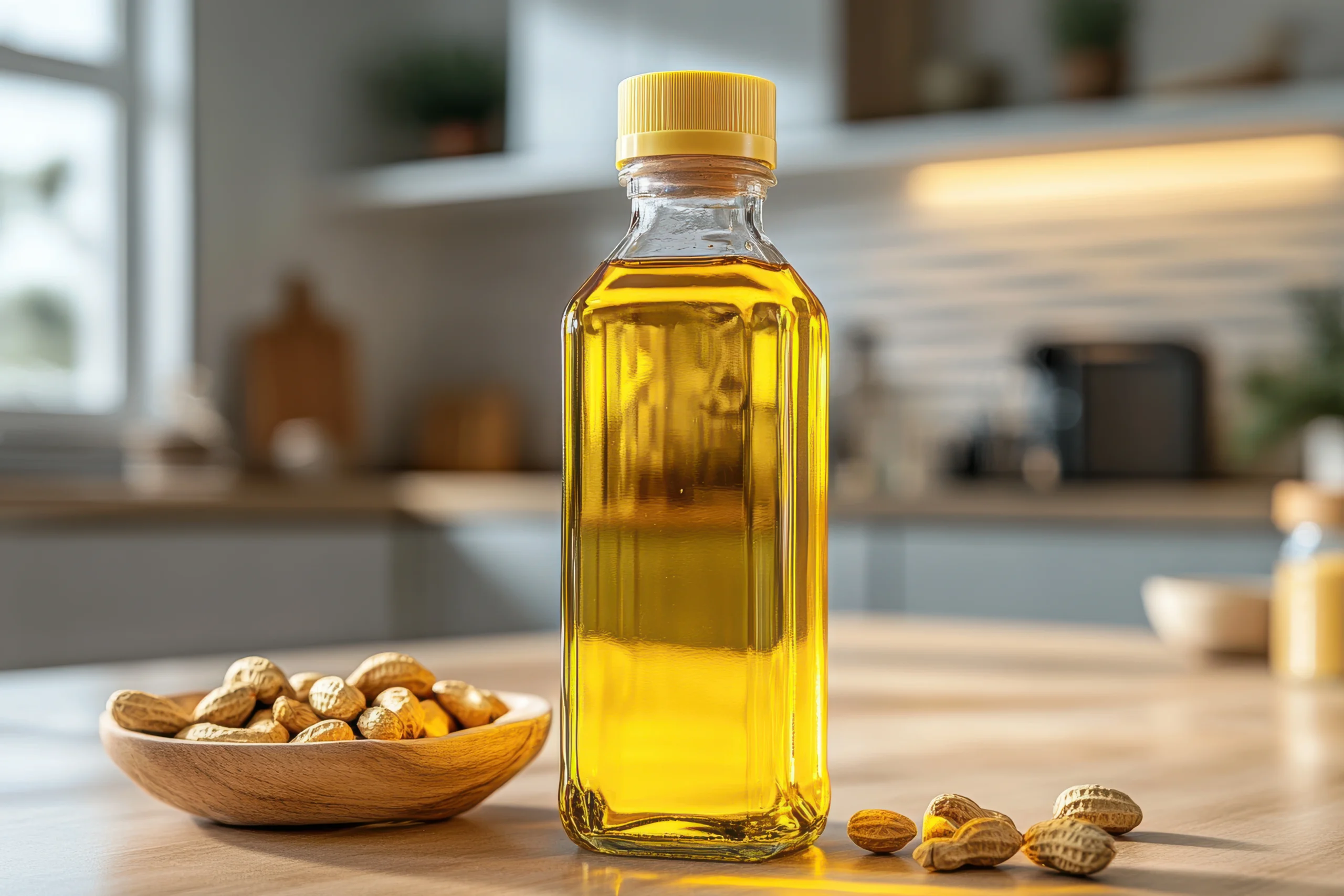
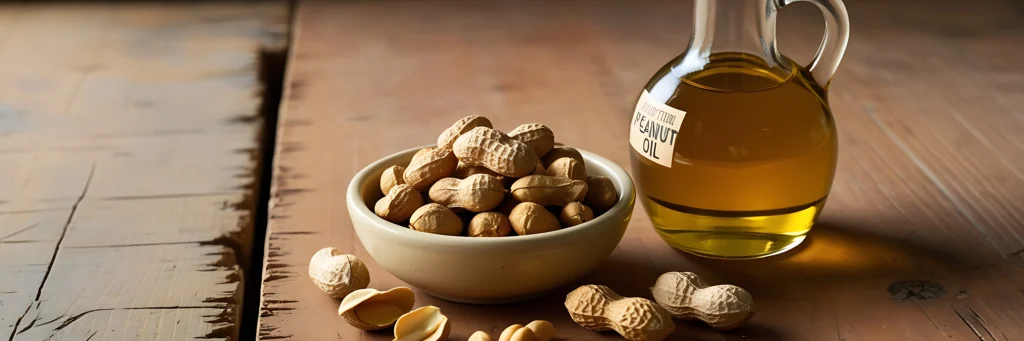
- Color: Refined peanut oil is light yellow and clear, while unrefined and roasted varieties may have a deeper golden color.
- Shape: As a liquid, peanut oil takes the shape of its container.
- Size: Available in various sizes, from small bottles to large containers for bulk use.
- Texture: It has a smooth, liquid texture at room temperature.
Culinary Uses
- Common Dishes: Peanut oil is widely used for frying, deep-frying, and sautéing due to its high smoke point. Roasted peanut oil, with its robust flavor, is often used in salad dressings, marinades, and as a finishing oil.
- Preparation Methods: Can be used directly from the bottle for cooking or as a dressing. Refined peanut oil is preferred for high-heat cooking, while unrefined or roasted oils are better suited for flavoring.
- Suitable Pairings: Peanut oil complements a wide range of dishes, including stir-fries, fried foods, and salads. Its nutty flavor, especially in unrefined and roasted varieties, pairs well with Asian cuisine.
Geographical Information
- Origin: The peanut plant, Arachis hypogaea, is believed to have originated in South America, with archaeological evidence suggesting its cultivation as far back as 7,500 years ago.
- Primary Growing Regions: Today, the leading producers of peanuts (and consequently peanut oil) include China, India, Nigeria, the United States (particularly Georgia, Texas, and Oklahoma), and Indonesia.
- Seasonal Availability: Peanut oil is available year-round, as peanuts are harvested and processed continuously in different regions around the world.
| proximates: | |
| Total fat (NLEA) | 93.4 g |
| Vitamins and Other Components: | |
| Vitamin E (alpha-tocopherol) | 15.2 mg |
| Tocopherol, beta | <9.97 mg |
| Tocopherol, gamma | 13.4 mg |
| Tocopherol, delta | <10.8 mg |
| Tocotrienol, alpha | <21.5 mg |
| Tocotrienol, beta | <21.5 mg |
| Tocotrienol, gamma | <21.5 mg |
| Tocotrienol, delta | <21.5 mg |
| Vitamin K (phylloquinone) | 4.3 µg |
| Lipids: | |
| Fatty acids, total saturated | 16.2 g |
| SFA 4:0 | 0.004 g |
| SFA 8:0 | 0.004 g |
| SFA 10:0 | 0.006 g |
| SFA 12:0 | 0.017 g |
| SFA 14:0 | 0.04 g |
| SFA 16:0 | 8.26 g |
| SFA 17:0 | 0.072 g |
| SFA 18:0 | 2.58 g |
| SFA 20:0 | 1.14 g |
| SFA 21:0 | 0.021 g |
| SFA 22:0 | 2.58 g |
| SFA 24:0 | 1.48 g |
| Fatty acids, total monounsaturated | 57.1 g |
| MUFA 16:1 c | 0.075 g |
| MUFA 17:1 | 0.055 g |
| MUFA 17:1 c | 0.055 g |
| MUFA 18:1 c | 55.4 g |
| MUFA 20:1 c | 1.41 g |
| MUFA 22:1 c | 0.136 g |
| MUFA 22:1 n-9 | 0.133 g |
| MUFA 22:1 n-11 | 0.003 g |
| MUFA 24:1 c | 0.013 g |
| Fatty acids, total polyunsaturated | 19.9 g |
| PUFA 18:2 c | 19.6 g |
| PUFA 18:2 n-6 c,c | 19.6 g |
| PUFA 18:2 CLAs | 0.021 g |
| PUFA 18:3 c | 0.318 g |
| PUFA 18:3 n-3 c,c,c (ALA) | 0.318 g |
| PUFA 20:2 c | 0.017 g |
| PUFA 20:2 n-6 c,c | 0.017 g |
| PUFA 20:3 c | 0.001 g |
| PUFA 20:3 n-3 | 0.001 g |
| PUFA 22:3 | 0.013 g |
| PUFA 20:4 | 0.003 g |
| PUFA 20:4c | 0.003 g |
| PUFA 20:5c | 0.001 g |
| PUFA 20:5 n-3 (EPA) | 0.001 g |
| PUFA 22:2 | 0.001 g |
| PUFA 22:4 | 0.001 g |
| Fatty acids, total trans | 0.172 g |
| Fatty acids, total trans-monoenoic | 0.034 g |
| TFA 18:1 t | 0.034 g |
| TFA 18:2 t not further defined | 0.139 g |
| TFA 18:2 t | 0.139 g |
| Phytosterols: | |
| Stigmastadiene | <1 mg |
| Stigmasterol | 17.8 mg |
| Campesterol | 33 mg |
| Brassicasterol | <0.5 mg |
| Beta-sitosterol | 122 mg |
| Campestanol | 0.14 mg |
| Beta-sitostanol | 3.58 mg |
| Delta-5-avenasterol | 16.4 mg |
| Delta-7-Stigmastenol | 8.2 mg |