

Basic Information
Name: Commonly known as Manzanilla Olives Stuffed with Pimiento. The scientific name for the olive tree is Olea europaea.
Category: Olives are categorized as fruit, specifically a type of drupe or stone fruit.
Varieties: Manzanilla olives are a specific variety of green olive known for their small size, firm texture, and slightly nutty flavor. The stuffing with pimiento (red bell pepper) adds a sweet and tangy contrast.
Nutritional Information
- Macronutrients: Green olives are low in carbs and proteins but high in fats, primarily monounsaturated fats (oleic acid). Stuffed olives may have slightly higher carb content due to the pimiento.
- Carbohydrates: 4.96 g.
- Proteins: 1.15 g
- Fats: 12.9
- Micronutrients: Olives are a good source of vitamin E, iron, copper, and calcium. They also contain significant amounts of sodium, especially when preserved in brine.
Phytonutrients
Green Manzanilla olives stuffed with pimiento are a popular variety of olives, known for their rich flavor and versatility in culinary uses. While they are often enjoyed for their taste and texture, they also contain a variety of phytonutrients that contribute to their health benefits. Here’s an overview of the key phytonutrients found in these olives:
1. Polyphenols
- Oleuropein: Found in high concentrations in green olives, oleuropein is known for its antioxidant properties. It can help protect cells from damage and has been linked to various health benefits, including heart health and anti-inflammatory effects.
- Hydroxytyrosol: A breakdown product of oleuropein during olive ripening or processing, hydroxytyrosol is another potent antioxidant. It’s known for its cardiovascular benefits, ability to protect against oxidative stress, and potential anti-inflammatory properties.
2. Flavonoids
- Quercetin: Green olives contain quercetin, a flavonoid with antioxidant, anti-inflammatory, and antihypertensive properties. It contributes to the olives’ ability to support cardiovascular health.
3. Vitamins and Minerals
- While not phytonutrients per se, green Manzanilla olives are a source of vitamin E (tocopherols) and minerals such as iron and calcium. Vitamin E acts as an antioxidant, protecting the body from oxidative stress.
Health Benefits
The phytonutrients in green Manzanilla olives with pimiento stuffing offer several health benefits:
- Antioxidant Support: The polyphenols and flavonoids in olives help neutralize free radicals, reducing oxidative stress and potentially lowering the risk of chronic diseases.
- Heart Health: Components like oleuropein and hydroxytyrosol support heart health by improving cholesterol levels, lowering blood pressure, and reducing inflammation.
- Anti-inflammatory Effects: The anti-inflammatory properties of the phytonutrients in olives can help reduce the risk of inflammatory diseases and support overall health.
Considerations
While green Manzanilla olives stuffed with pimiento are nutritious, they are also high in sodium due to the brining process, which should be considered if you are monitoring your sodium intake. Including them as part of a balanced diet can help you enjoy their flavors and health benefits without consuming excessive sodium.
Calorie Count and Glycemic Index
- Calorie Count: Approximately 141 calories per 100 grams.
- Glycemic Index: Olives have a low glycemic index due to their low carbohydrate content.
Physical Characteristics
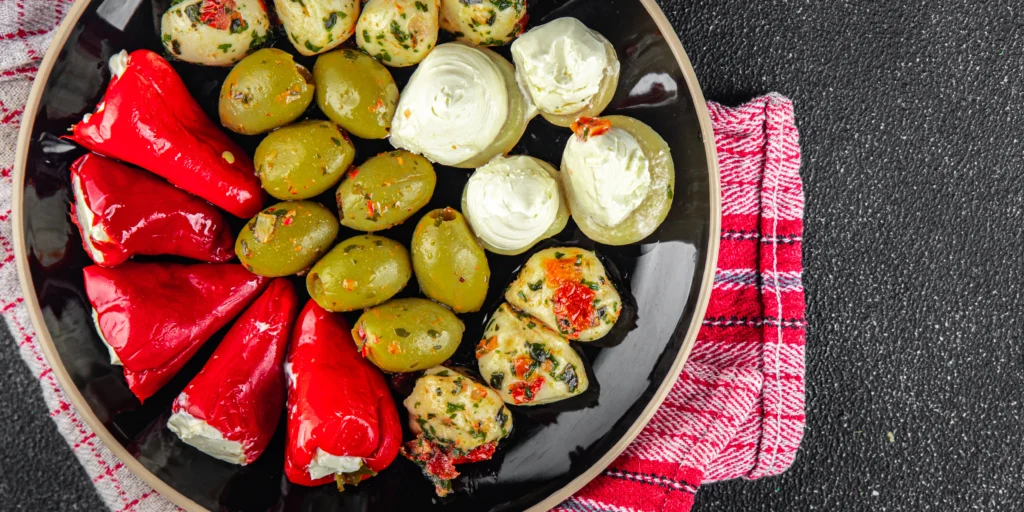
- Color: Manzanilla olives are light to medium green, with the pimiento stuffing adding a bright red contrast.
- Shape: Typically round to oval, with a small pit inside. The pimiento stuffing is usually finely chopped or pureed and inserted into the pitted olive.
- Size: Manzanilla olives are small to medium-sized, with each olive being about the size of a marble or slightly larger.
- Texture: Firm and slightly chewy, with the pimiento stuffing providing a softer texture contrast.
Culinary Uses
- Common Dishes: Stuffed Manzanilla olives are often served as appetizers or tapas, included in salads, and used as garnishes for cocktails like martinis. They are also a popular ingredient in Mediterranean dishes.
- Preparation Methods: Ready to eat straight from the jar or can, requiring no further preparation.
- Suitable Pairings: Pair well with cheeses, cured meats, and a variety of alcoholic and non-alcoholic beverages. They complement Mediterranean and Spanish dishes beautifully.
Geographical Information
- Origin: The olive tree, Olea europaea, is native to the Mediterranean region. The Manzanilla variety is especially popular in Spain, where it is widely cultivated.
- Primary Growing Regions: Manzanilla olives are primarily grown in Spain, especially in the Andalusia region. However, they are also cultivated in other parts of the Mediterranean and in California, USA.
- Seasonal Availability: Olives are harvested in the early fall but are available year-round due to processing and preservation methods.
| proximates: | |
| Water | 76.7 g |
| Energy (Atwater General Factors) | 141 kcal |
| Energy (Atwater Specific Factors) | 130 kcal |
| Nitrogen | 0.18 g |
| Protein | 1.15 g |
| Total lipid (fat) | 12.9 g |
| Total fat (NLEA) | 11.8 g |
| Ash | 4.29 g |
| Carbohydrates: | |
| Carbohydrate, by difference | 4.96 g |
| Carbohydrate, by summation | 4.32 g |
| Fiber, total dietary | 4 g |
| Starch | 0.33 g |
| Minerals: | |
| Calcium, Ca | 121 mg |
| Iron, Fe | 0.31 mg |
| Magnesium, Mg | 12.4 mg |
| Phosphorus, P | 7 mg |
| Potassium, K | 43 mg |
| Sodium, Na | 1620 mg |
| Zinc, Zn | 0.09 mg |
| Copper, Cu | 0.107 mg |
| Manganese, Mn | 0.047 mg |
| Vitamins and Other Components: | |
| Thiamin | 0.041 mg |
| Niacin | 0.103 mg |
| Choline, total | 1.6 mg |
| Choline, free | 0.6 mg |
| Choline, from phosphocholine | 0.7 mg |
| Choline, from glycerophosphocholine | 0.3 mg |
| Betaine | 0.1 mg |
| Vitamin A, RAE | 25 µg |
| Carotene, beta | 272 µg |
| Carotene, alpha | 2 µg |
| Cryptoxanthin, beta | 48 µg |
| Lutein + zeaxanthin | 340 µg |
| Vitamin E (alpha-tocopherol) | 3.78 mg |
| Tocopherol, beta | 0.02 mg |
| Tocopherol, gamma | 0.1 mg |
| Vitamin K (phylloquinone) | 16.6 µg |
| Lipids: | |
| Fatty acids, total saturated | 2.3 g |
| SFA 4:0 | 0.01 g |
| SFA 10:0 | 0.001 g |
| SFA 14:0 | 0.003 g |
| SFA 15:0 | 0.001 g |
| SFA 16:0 | 1.87 g |
| SFA 17:0 | 0.018 g |
| SFA 18:0 | 0.323 g |
| SFA 20:0 | 0.053 g |
| SFA 22:0 | 0.015 g |
| SFA 24:0 | 0.01 g |
| Fatty acids, total monounsaturated | 8.86 g |
| MUFA 16:1 c | 0.151 g |
| MUFA 17:1 | 0.033 g |
| MUFA 17:1 c | 0.033 g |
| MUFA 18:1 c | 8.64 g |
| MUFA 20:1 c | 0.031 g |
| Fatty acids, total polyunsaturated | 0.661 g |
| PUFA 18:2 c | 0.557 g |
| PUFA 18:2 n-6 c,c | 0.557 g |
| PUFA 18:3 c | 0.104 g |
| PUFA 18:3 n-3 c,c,c (ALA) | 0.104 g |