

Basic Information
- Common Name: Green Bell Pepper
- Scientific Name: Capsicum annuum
- Category: Vegetable
Varieties
Bell peppers come in several colors, including red, yellow, orange, and green, which is simply the unripe version of these peppers. While not technically different varieties in the botanical sense, the color difference represents different stages of ripeness, with green being the least ripe and therefore slightly less sweet than the others.
Nutritional Information
- Macronutrients:
- Carbohydrates: Approximately 4.78g per 100g, mainly composed of sugars and dietary fiber.
- Proteins: About 0.72g per 100g.
- Fats: Minimal, around 0.11g per 100g.
- Micronutrients: Green bell peppers are rich in Vitamin C, Vitamin A (through beta-carotene), and also provide Vitamin K, Vitamin E, and Vitamin B6. They contain essential minerals like potassium and manganese.
Phytonutrients
Green bell peppers, like all colored bell peppers, are rich in various phytonutrients that contribute to their nutritional value and health benefits. These compounds play a significant role in protecting the body against oxidative stress and inflammation, among other health advantages. Here’s an overview of the key phytonutrients present in raw green bell peppers:
Carotenoids
- Beta-carotene: Although green bell peppers have lower beta-carotene levels compared to their red, yellow, or orange counterparts, they still contain this important antioxidant, which the body can convert into vitamin A.
- Lutein and Zeaxanthin: These are specifically concentrated in the retina of the eye and are known for protecting vision by filtering harmful light wavelengths.
Flavonoids
- Quercetin: A powerful antioxidant with anti-inflammatory properties that may help reduce the risk of chronic diseases such as heart disease and cancer.
- Luteolin: Also possesses antioxidant and anti-inflammatory effects, potentially supporting brain health and reducing the risk of inflammatory diseases.
Vitamins
- Vitamin C: Green bell peppers are an excellent source of vitamin C, an essential antioxidant that supports the immune system, skin health, and iron absorption.
- Vitamin E: Provides antioxidant properties that help protect cells from oxidative damage.
Capsaicinoids
- While capsaicin is more prominently associated with hot peppers, green bell peppers contain trace amounts of capsaicinoids, which have been linked to various health benefits, including pain relief and reducing inflammation, albeit in much lower intensities due to their mild flavor.
Saponins
- Though not as extensively researched, saponins found in bell peppers may have immune-boosting and cholesterol-lowering effects.
Health Benefits of Phytonutrients in Green Bell Peppers
The combination of these phytonutrients in green bell peppers contributes to several health benefits:
- Antioxidant Activity: The various antioxidants help neutralize free radicals, reducing oxidative stress and potentially lowering the risk of chronic diseases.
- Eye Health: Lutein and zeaxanthin are crucial for maintaining healthy vision and may help prevent age-related macular degeneration.
- Inflammatory and Pain Reduction: Though in minimal amounts, capsaicinoids can offer anti-inflammatory benefits and may contribute to pain reduction.
- Heart Health: The flavonoids and vitamin C in green bell peppers can contribute to cardiovascular health by improving endothelial function and reducing LDL cholesterol levels.
Incorporating green bell peppers into your diet can thus offer a range of health benefits, making them a valuable addition to a balanced and nutritious diet.

Calorie Count and Glycemic Index
- Calorie Count: About 20 calories per 100g.
- Glycemic Index: Low, approximately 15-20, making them a good choice for blood sugar management.
Physical Characteristics
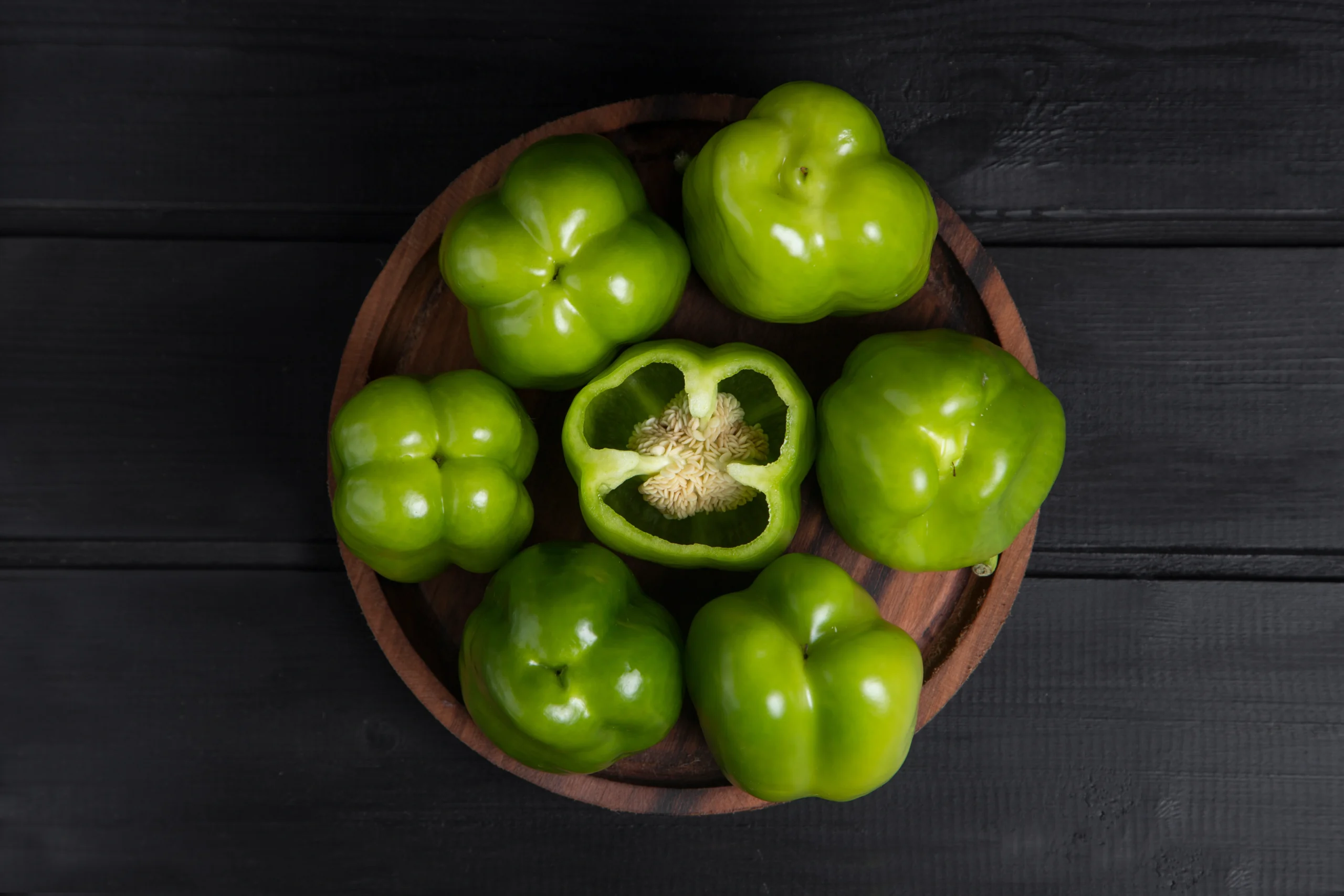
- Color: Vibrant green, indicating they are less ripe than their yellow, orange, and red counterparts.
- Shape: Blocky, with three or four lobes, and a hollow interior divided by membranes to which seeds are attached.
- Size: Typically ranges from 2 to 5 inches in diameter and 2 to 6 inches in length.
- Texture: Crisp and firm when raw, softens when cooked.
Culinary Uses
Green bell peppers are extremely versatile in the kitchen. They can be:
- Eaten Raw: Sliced or chopped in salads, as sticks for dips, or as a crunchy addition to sandwiches.
- Cooked: Stir-fried, roasted, grilled, or stuffed. Common in a variety of cuisines, including Mediterranean, Asian, and Mexican.
- Common Dishes: Fajitas, stir-fries, salads, stuffed peppers, and ratatouille.
- Preparation Methods: Can be grilled, roasted, sautéed, or eaten raw.
- Suitable Pairings: Complements a wide range of ingredients, including meats, other vegetables, grains, and cheeses.
Geographical Information
- Origin: Native to Central and South America.
- Primary Growing Regions: Today, bell peppers are cultivated worldwide, with China, Mexico, the United States, Indonesia, and Turkey among the top producers.
- Seasonal Availability: While they can be found year-round due to global agriculture, they are in peak season during the summer and early fall.
Green bell peppers, with their crisp texture and mildly sweet yet tangy flavor, are a staple in many dishes around the world. Their nutritional profile makes them a healthy addition to any meal, providing essential vitamins and minerals with a low calorie and glycemic index.
| proximates: | |
| Water | 94.1 g |
| Energy (Atwater General Factors) | 23 kcal |
| Energy (Atwater Specific Factors) | 20 kcal |
| Nitrogen | 0.11 g |
| Protein | 0.72 g |
| Total lipid (fat) | 0.11 g |
| Ash | 0.28 g |
| Carbohydrates: | |
| Carbohydrate, by difference | 4.78 g |
| Fiber, total dietary | 0.9 g |
| Minerals: | |
| Calcium, Ca | 7 mg |
| Iron, Fe | 0.19 mg |
| Magnesium, Mg | 9 mg |
| Phosphorus, P | 17 mg |
| Potassium, K | 163 mg |
| Sodium, Na | <2.49 mg |
| Zinc, Zn | 0.13 mg |
| Copper, Cu | 0.058 mg |
| Manganese, Mn | 0.1 mg |
| Selenium, Se | <2.5 µg |
| Vitamins and Other Components: | |
| Vitamin C, total ascorbic acid | 99.5 mg |
| Thiamin | 0.039 mg |
| Riboflavin | 0.089 mg |
| Niacin | 0.636 mg |
| Vitamin B-6 | 0.247 mg |
| Biotin | <3.7 µg |
| Folate, total | 22 µg |