

Basic Information
Name:
- Common: Sweet and Sour Pork
- Category: Main Course, Meat Dish
Varieties:
- Traditional: Typically includes pork, bell peppers, pineapple, and a sweet and sour sauce.
- Regional Variations: Different regions in China and other countries have unique twists, such as the addition of different vegetables or fruits, or variations in the sauce ingredients.
- Modern Variations: Healthier versions with leaner cuts of pork or substitutions like chicken or tofu.
Nutritional Information (per 1 cup/200 grams serving)
Macronutrients:
- Carbohydrates: 25.5 grams
- Proteins: 8.88 grams
- Fats: 13.6 grams
- Saturated fats: 2-3 grams
- Polyunsaturated fats: 3-4 grams
- Monounsaturated fats: 4-5 grams
Micronutrients:
- Vitamins:
- Vitamin C: 20-30% of the Daily Value (DV) (from bell peppers and pineapple)
- Vitamin A: 10-15% DV (from bell peppers)
- Vitamin B6: 10% DV (from pork)
- Minerals:
- Iron: 8-12% DV
- Magnesium: 6-8% DV
- Phosphorus: 15-20% DV
- Potassium: 8-10% DV
Calorie Count:
- Approximately 300-350 calories per 1 cup (200 grams)
Glycemic Index:
- Moderate to high, typically around 65-75 due to the sugar in the sauce and the presence of pineapple.
Phytonutrients
weet and sour pork contains several key phytonutrients from its vegetable and fruit components:
1. Carotenoids:
- Includes: Beta-carotene (from bell peppers).
- Benefits: Supports eye health and immune function, and acts as an antioxidant.
2. Flavonoids:
- Includes: Quercetin (from bell peppers and onions).
- Benefits: Provides antioxidant and anti-inflammatory properties, helping to protect against oxidative stress and inflammation.
3. Phenolic Acids:
- Includes: Chlorogenic acid and caffeic acid (from bell peppers).
- Benefits: Contributes to reducing inflammation, preventing cancer, and protecting cardiovascular health.
4. Polyphenols:
- Includes: Catechins and epicatechins (from vegetables and pineapple).
- Benefits: Helps improve heart health by lowering blood pressure and reducing LDL cholesterol levels.
5. Bromelain:
- Source: Pineapple.
- Benefits: Acts as a digestive enzyme, helping to break down proteins, and has anti-inflammatory and immune-boosting properties.
These phytonutrients contribute to the overall health-promoting properties of sweet and sour pork, offering antioxidant, anti-inflammatory, and digestive benefits. The presence of vegetables and fruits enhances the nutritional value of this popular Chinese dish.
Physical Characteristics
Color:
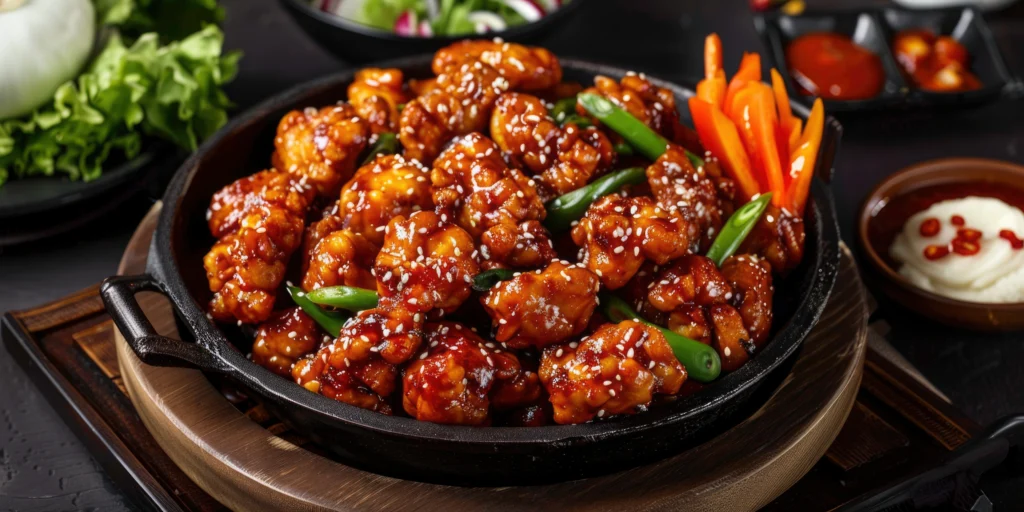
- Bright and colorful, with red, green, and yellow bell peppers, golden-brown pork, and vibrant yellow pineapple chunks.
Shape:
- Bite-sized chunks of pork, diced or sliced bell peppers, and pineapple pieces.
Size:
- Each piece of pork is typically 1-2 inches in size, with similarly sized vegetable and fruit pieces.
Texture:
- Mouthfeel: Crispy exterior on the pork due to battering and frying, with tender and juicy meat inside.
- Consistency: The sauce is thick and glossy, coating the pork and vegetables evenly.
Aroma and Flavor:
- Aroma: A sweet, tangy, and slightly savory fragrance with hints of vinegar and pineapple.
- Flavor: A balanced combination of sweetness from sugar and pineapple, tanginess from vinegar, and savory notes from soy sauce and fried pork.
Culinary Uses
Common Dishes:
- Main Course: Typically served as a main dish in Chinese cuisine.
- Accompaniment: Often served with steamed rice, fried rice, or noodles.
Preparation Methods:
- Ingredients: Pork (often pork loin or tenderloin), bell peppers (red, green, yellow), pineapple chunks, onion, garlic, ginger, sugar, vinegar (usually rice or white vinegar), ketchup, soy sauce, cornstarch, and sometimes tomato paste.
- Cooking Technique:
- Marinating: Pork is often marinated in a mixture of soy sauce, garlic, and ginger.
- Battering and Frying: Pork pieces are coated in cornstarch (or a batter) and deep-fried until crispy.
- Sautéing: Vegetables and pineapple are briefly sautéed to retain their crunch.
- Sauce Preparation: Sauce is made by combining sugar, vinegar, ketchup, and soy sauce, and thickened with cornstarch.
- Combining: Fried pork is mixed with vegetables and pineapple in the sauce, ensuring everything is evenly coated.
Suitable Pairings:
- Starches: Steamed rice, fried rice, lo mein noodles.
- Vegetables: Steamed broccoli, snow peas, or a simple vegetable stir-fry.
- Other Dishes: Often served alongside other Chinese dishes such as egg rolls, hot and sour soup, or spring rolls.
Geographical Information
Origin:
- Sweet and Sour Pork is believed to have originated from the Guangdong (Canton) province of China. It is a staple in Cantonese cuisine and has been adapted and popularized in many Chinese restaurants worldwide.
Primary Growing Regions for Key Ingredients:
- Pork: Widely farmed globally, with significant production in China, the United States, and Europe.
- Bell Peppers: Grown in various regions, including China, the United States, Mexico, and Spain.
- Pineapple: Primarily produced in tropical regions, with major producers including Thailand, the Philippines, Costa Rica, and India.
Seasonal Availability:
- Available year-round due to the non-seasonal nature of the ingredients and the ability to use canned pineapple and bell peppers from controlled environments. Fresh bell peppers and pineapples are seasonally available but can be sourced throughout the year thanks to global trade.
| Proximates: | |
| Water | 50.8 g |
| Energy (Atwater General Factors) | 260 kcal |
| Nitrogen | 1.42 g |
| Protein | 8.88 g |
| Total lipid (fat) | 13.6 g |
| Total fat (NLEA) | 13.3 g |
| Ash | 1.25 g |
| Carbohydrates: | |
| Carbohydrate, by difference | 25.5 g |
| Carbohydrate, by summation | 23 g |
| Fiber, total dietary | 1 g |
| Sugars, Total | 10.3 g |
| Sucrose | 4.47 g |
| Glucose | 3.01 g |
| Fructose | 2.85 g |
| Starch | 11.7 g |
| Minerals: | |
| Calcium, Ca | 46 mg |
| Iron, Fe | 3.07 mg |
| Magnesium, Mg | 13 mg |
| Phosphorus, P | 133 mg |
| Potassium, K | 152 mg |
| Sodium, Na | 304 mg |
| Zinc, Zn | 1.07 mg |
| Copper, Cu | 0.06 mg |
| Manganese, Mn | 0.173 mg |
| Selenium, Se | 9.7 µg |
| Vitamins and Other Components: | |
| Vitamin C, total ascorbic acid | 2.3 mg |
| Thiamin | 0.235 mg |
| Riboflavin | 0.103 mg |
| Niacin | 2.11 mg |
| Pantothenic acid | 0.443 mg |
| Vitamin B-6 | 0.17 mg |
| Choline, total | 32.4 mg |
| Choline, free | 3.5 mg |
| Choline, from phosphocholine | 0.8 mg |
| Choline, from phosphotidyl choline | 16.2 mg |
| Choline, from glycerophosphocholine | 7.3 mg |
| Choline, from sphingomyelin | 4.6 mg |
| Betaine | 7.4 mg |
| Vitamin B-12 | 0.19 µg |
| Vitamin A, RAE | 29 µg |
| Retinol | 2 µg |
| Carotene, beta | 259 µg |
| Carotene, alpha | 139 µg |
| Lycopene | 199 µg |
| Lutein + zeaxanthin | 22 µg |
| Vitamin E (alpha-tocopherol) | 0.89 mg |
| Tocopherol, beta | 0.06 mg |
| Tocopherol, gamma | 3.27 mg |
| Tocopherol, delta | 1.28 mg |
| Tocotrienol, gamma | 0.01 mg |
| Vitamin K (phylloquinone) | 27.8 µg |
| Vitamin K (Menaquinone-4) | 2 µg |
| Lipids: | |
| Fatty acids, total saturated | 2.68 g |
| SFA 4:0 | 0.003 g |
| SFA 8:0 | 0.006 g |
| SFA 10:0 | 0.005 g |
| SFA 12:0 | 0.003 g |
| SFA 14:0 | 0.042 g |
| SFA 15:0 | 0.004 g |
| SFA 16:0 | 1.79 g |
| SFA 17:0 | 0.018 g |
| SFA 18:0 | 0.719 g |
| SFA 20:0 | 0.039 g |
| SFA 22:0 | 0.035 g |
| SFA 24:0 | 0.012 g |
| Fatty acids, total monounsaturated | 3.49 g |
| MUFA 14:1 c | 0.002 g |
| MUFA 16:1 c | 0.074 g |
| MUFA 17:1 | 0.015 g |
| MUFA 17:1 c | 0.015 g |
| MUFA 18:1 c | 3.32 g |
| MUFA 20:1 | 0.072 g |
| MUFA 20:1 c | 0.072 g |
| MUFA 22:1 c | 0.004 g |
| MUFA 24:1 c | 0.003 g |
| Fatty acids, total polyunsaturated | 7.05 g |
| PUFA 18:2 c | 6.21 g |
| PUFA 18:2 n-6 c,c | 6.2 g |
| PUFA 18:2 CLAs | 0.014 g |
| PUFA 18:3 c | 0.786 g |
| PUFA 18:3 n-3 c,c,c (ALA) | 0.785 g |
| PUFA 18:3 n-6 c,c,c | 0.001 g |
| PUFA 20:2 c | 0.013 g |
| PUFA 20:2 n-6 c,c | 0.013 g |
| PUFA 20:3 c | 0.006 g |
| PUFA 20:3 n-3 | 0.002 g |
| PUFA 20:3 n-6 | 0.004 g |
| PUFA 20:4 | 0.025 g |
| PUFA 20:4c | 0.025 g |
| PUFA 20:5c | 0.004 g |
| PUFA 20:5 n-3 (EPA) | 0.004 g |
| PUFA 22:5 c | 0.003 g |
| PUFA 22:4 | 0.005 g |
| PUFA 22:5 n-3 (DPA) | 0.003 g |
| PUFA 22:6 c | 0.002 g |
| PUFA 22:6 n-3 (DHA) | 0.002 g |
| Fatty acids, total trans | 0.087 g |
| Fatty acids, total trans-monoenoic | 0.034 g |
| TFA 16:1 t | 0.001 g |
| TFA 18:1 t | 0.03 g |
| TFA 22:1 t | 0.003 g |
| Fatty acids, total trans-dienoic | 0.052 g |
| TFA 18:2 t not further defined | 0.052 g |
| Cholesterol | 24 mg |
| Amino acids: | |
| Tryptophan | 0.102 g |
| Threonine | 0.373 g |
| Isoleucine | 0.377 g |
| Leucine | 0.707 g |
| Lysine | 0.663 g |
| Methionine | 0.207 g |
| Cystine | 0.11 g |
| Phenylalanine | 0.343 g |
| Tyrosine | 0.253 g |
| Valine | 0.41 g |
| Arginine | 0.54 g |
| Histidine | 0.287 g |
| Alanine | 0.473 g |
| Aspartic acid | 0.767 g |
| Glutamic acid | 1.87 g |
| Glycine | 0.4 g |
| Proline | 0.447 g |
| Serine | 0.38 g |