
Basic Information
Name:
- Common: Pupusas con Frijoles
- Scientific: Not applicable (culinary dish)
- Category: Main Course, Traditional Latin American Dish
Varieties:
- Pupusas con Queso: Filled with cheese.
- Pupusas Revueltas: Filled with a combination of cheese, beans, and pork.
- Vegetarian Pupusas: Filled with vegetables and beans.
Nutritional Information (per 1 medium pupusa, approximately 100 grams)
Macronutrients:
- Carbohydrates: 31.5 grams
- Proteins: 5.59 grams
- Fats: 9.01 grams
- Saturated fats: 2-3 grams
- Polyunsaturated fats: 1-2 grams
- Monounsaturated fats: 2-3 grams
Micronutrients:
- Vitamins:
- Vitamin A: 2-4% of the Daily Value (DV)
- Vitamin C: 2-3% DV (from accompanying curtido)
- Vitamin B6: 5-8% DV (from beans)
- Folate: 10-15% DV (from beans and masa)
- Minerals:
- Iron: 10-15% DV (from beans and masa)
- Magnesium: 6-8% DV
- Phosphorus: 10-12% DV
- Potassium: 4-6% DV
Calorie Count:
- Approximately 200-250 calories per pupusa
Glycemic Index:
- Moderate, typically around 50-60 due to the corn masa.
Phytonutrients
Pupusas con frijoles contain several key phytonutrients from their ingredients:
1. Carotenoids:
- Includes: Beta-carotene (from accompanying curtido if it includes carrots).
- Benefits: Supports eye health and immune function, and acts as an antioxidant.
2. Flavonoids:
- Includes: Quercetin (from onions in curtido and salsa roja).
- Benefits: Provides antioxidant and anti-inflammatory properties, helping to protect against oxidative stress and inflammation.
3. Phenolic Acids:
- Includes: Chlorogenic acid and caffeic acid (from beans).
- Benefits: Contributes to reducing inflammation, preventing cancer, and protecting cardiovascular health.
4. Polyphenols:
- Includes: Catechins and epicatechins (from beans).
- Benefits: Helps improve heart health by lowering blood pressure and reducing LDL cholesterol levels.
5. Fiber:
- Includes: Soluble and insoluble fiber (from beans and corn masa).
- Benefits: Supports digestive health and helps maintain healthy cholesterol levels.
These phytonutrients contribute to the overall health-promoting properties of pupusas con frijoles, offering antioxidant, anti-inflammatory, and digestive benefits. The presence of beans and corn masa enhances the nutritional value of this traditional Salvadoran dish.
Physical Characteristics
Color:
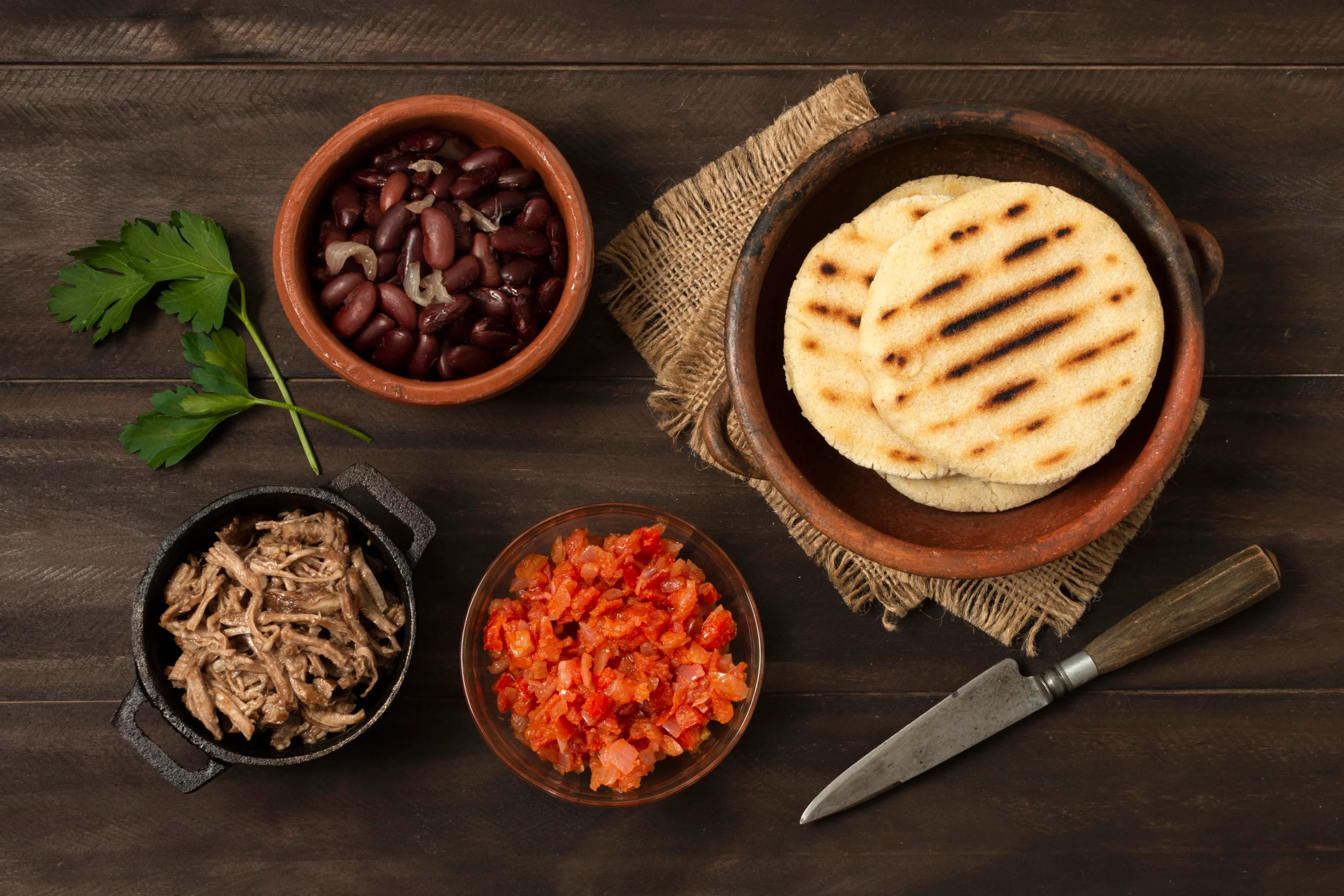
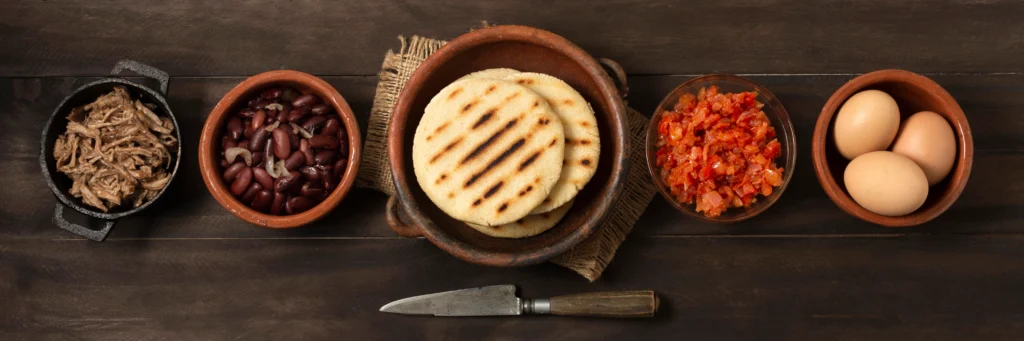
- Light golden brown exterior with possible char marks from the griddle, with a creamy beige interior from the masa and darker brown filling from the beans.
Shape:
- Round and flat, resembling a thick pancake or flatbread, typically about 4-6 inches in diameter.
Size:
- Each pupusa is about 1/2 inch thick and 4-6 inches in diameter.
Texture:
- Mouthfeel: Slightly crispy on the outside with a soft and chewy interior.
- Consistency: Homogeneous masa with a smooth bean filling.
Aroma and Flavor:
- Aroma: A warm, toasty scent from the griddled masa with a savory aroma from the beans.
- Flavor: Mildly sweet and nutty flavor from the corn masa, complemented by the earthy and slightly salty taste of the beans.
Culinary Uses
Common Dishes:
- Main Course: Often served as a main dish for breakfast, lunch, or dinner.
- Side Dish: Can accompany soups or salads.
Preparation Methods:
- Ingredients: Corn masa (dough made from masa harina and water), refried beans, salt, and sometimes lard or oil.
- Cooking Technique:
- Mixing: Prepare the masa by mixing masa harina with water and a pinch of salt until a dough forms.
- Filling: Flatten a small ball of masa dough, place a spoonful of refried beans in the center, and then fold the edges over the filling, flattening again to form a disc.
- Grilling: Cook on a hot griddle or comal over medium heat until both sides are golden brown and slightly crispy, about 4-5 minutes per side.
Suitable Pairings:
- Curtido: A traditional Salvadoran fermented cabbage slaw with carrots and onions, providing a tangy contrast.
- Salsa Roja: A mild tomato-based sauce often served alongside pupusas.
- Avocado: Fresh slices of avocado or guacamole complement the dish well.
- Fried Plantains: Adds a sweet and starchy component to the meal.
- Beans and Rice: As side dishes to complete a full meal.
Geographical Information
Origin:
- Pupusas originate from El Salvador and are considered the national dish. They have been a part of Salvadoran cuisine for centuries and are a staple in the diet of many Salvadorans.
Primary Growing Regions for Key Ingredients:
- Corn: Widely grown throughout Central and North America, with significant production in the United States, Mexico, and El Salvador.
- Beans: Commonly grown in various regions, including Latin America, the United States, and Africa.
Seasonal Availability:
- Available year-round, as the main ingredients (corn masa and beans) are non-seasonal and can be stored for long periods. Fresh ingredients for curtido and salsa roja are also readily available throughout the year in most regions.
| Proximates: | |
| Water | 52.2 g |
| Energy (Atwater General Factors) | 229 kcal |
| Nitrogen | 0.9 g |
| Protein | 5.59 g |
| Total lipid (fat) | 9.01 g |
| Total fat (NLEA) | 8.08 g |
| Ash | 1.74 g |
| Carbohydrates: | |
| Carbohydrate, by difference | 31.5 g |
| Carbohydrate, by summation | 30.7 g |
| Fiber, total dietary | 5.8 g |
| Sugars, Total | 1.3 g |
| Sucrose | 0.76 g |
| Fructose | 0.22 g |
| Maltose | 0.32 g |
| Starch | 23.6 g |
| Minerals: | |
| Calcium, Ca | 51 mg |
| Iron, Fe | 1.46 mg |
| Magnesium, Mg | 53.6 mg |
| Phosphorus, P | 144 mg |
| Potassium, K | 305 mg |
| Sodium, Na | 305 mg |
| Zinc, Zn | 0.94 mg |
| Copper, Cu | 0.141 mg |
| Manganese, Mn | 0.344 mg |
| Selenium, Se | 7 µg |
| Vitamins and Other Components: | |
| Thiamin | 0.077 mg |
| Riboflavin | 0.03 mg |
| Niacin | 0.867 mg |
| Pantothenic acid | 0.303 mg |
| Vitamin B-6 | 0.172 mg |
| Choline, total | 39.6 mg |
| Choline, free | 21.9 mg |
| Choline, from phosphocholine | 13.7 mg |
| Choline, from phosphotidyl choline | 0.4 mg |
| Choline, from glycerophosphocholine | 1.4 mg |
| Choline, from sphingomyelin | 2.3 mg |
| Betaine | 0.8 mg |
| Vitamin E (alpha-tocopherol) | 0.36 mg |
| Tocopherol, beta | 0.04 mg |
| Tocopherol, gamma | 4.13 mg |
| Tocopherol, delta | 0.66 mg |
| Tocotrienol, alpha | 0.11 mg |
| Tocotrienol, beta | 0.02 mg |
| Tocotrienol, gamma | 0.27 mg |
| Tocotrienol, delta | 0.01 mg |
| Vitamin K (phylloquinone) | 7.4 µg |
| Vitamin K (Menaquinone-4) | 0.8 µg |
| Lipids: | |
| Fatty acids, total saturated | 2.19 g |
| SFA 4:0 | 0.004 g |
| SFA 6:0 | 0.002 g |
| SFA 8:0 | 0.003 g |
| SFA 10:0 | 0.008 g |
| SFA 12:0 | 0.007 g |
| SFA 14:0 | 0.069 g |
| SFA 15:0 | 0.005 g |
| SFA 16:0 | 1.42 g |
| SFA 17:0 | 0.021 g |
| SFA 18:0 | 0.607 g |
| SFA 20:0 | 0.023 g |
| SFA 22:0 | 0.012 g |
| SFA 24:0 | 0.008 g |
| Fatty acids, total monounsaturated | 2.95 g |
| MUFA 14:1 c | 0.003 g |
| MUFA 16:1 c | 0.102 g |
| MUFA 17:1 | 0.015 g |
| MUFA 17:1 c | 0.015 g |
| MUFA 18:1 c | 2.77 g |
| MUFA 20:1 | 0.056 g |
| MUFA 20:1 c | 0.056 g |
| MUFA 22:1 c | 0.002 g |
| MUFA 24:1 c | 0.001 g |
| Fatty acids, total polyunsaturated | 2.88 g |
| PUFA 18:2 c | 2.5 g |
| PUFA 18:2 n-6 c,c | 2.49 g |
| PUFA 18:2 CLAs | 0.01 g |
| PUFA 18:3 c | 0.33 g |
| PUFA 18:3 n-3 c,c,c (ALA) | 0.329 g |
| PUFA 18:3 n-6 c,c,c | 0.001 g |
| PUFA 20:2 c | 0.027 g |
| PUFA 20:2 n-6 c,c | 0.027 g |
| PUFA 20:3 c | 0.009 g |
| PUFA 20:3 n-3 | 0.004 g |
| PUFA 20:3 n-6 | 0.004 g |
| PUFA 20:4 | 0.011 g |
| PUFA 20:4c | 0.011 g |
| PUFA 20:5c | 0.003 g |
| PUFA 20:5 n-3 (EPA) | 0.003 g |
| PUFA 22:2 | 0.001 g |
| PUFA 22:5 c | 0.003 g |
| PUFA 22:4 | 0.004 g |
| PUFA 22:5 n-3 (DPA) | 0.003 g |
| PUFA 22:6 c | 0.001 g |
| PUFA 22:6 n-3 (DHA) | 0.001 g |
| Fatty acids, total trans | 0.057 g |
| Fatty acids, total trans-monoenoic | 0.038 g |
| TFA 16:1 t | 0.002 g |
| TFA 18:1 t | 0.035 g |
| TFA 22:1 t | 0.001 g |
| Fatty acids, total trans-dienoic | 0.019 g |
| TFA 18:2 t not further defined | 0.019 g |
| Amino acids: | |
| Tryptophan | 0.057 g |
| Threonine | 0.22 g |
| Isoleucine | 0.227 g |
| Leucine | 0.543 g |
| Lysine | 0.303 g |
| Methionine | 0.103 g |
| Cystine | 0.08 g |
| Phenylalanine | 0.3 g |
| Tyrosine | 0.143 g |
| Valine | 0.267 g |
| Arginine | 0.303 g |
| Histidine | 0.17 g |
| Alanine | 0.3 g |
| Aspartic acid | 0.563 g |
| Glutamic acid | 1 g |
| Glycine | 0.217 g |
| Proline | 0.31 g |
| Serine | 0.32 g |