

Basic Information
- Common Name: Mild Italian Pork Sausage
- Scientific Name: N/A (Sausage is a processed food product made from pork and not classified under a scientific name.)
- Category: Food Product (Meat)
- Varieties: Italian sausage typically comes in two varieties based on flavor: mild (sweet) and hot. The primary difference lies in the spices used, with mild Italian sausage often flavored with fennel and without the spicy peppers found in hot versions.
Nutritional Information
- Macronutrients (per 100 grams of cooked, pan-fried mild Italian pork sausage):
- Carbohydrates: About 2-3 grams, mainly from added sugars or fillers in some recipes.
- Proteins: Approximately 25.2 grams, providing a good source of high-quality protein.
- Fats: 26.2 grams, with a mix of saturated and unsaturated fats. The exact amount can vary depending on the meat’s fat content and any added ingredients.
- Micronutrients: Source of B vitamins (niacin, vitamin B12, vitamin B6), iron, zinc, and phosphorus.
- Calorie Count: Roughly 290-350 calories per 100 grams.
- Glycemic Index: Low, due to the minimal carbohydrate content.
Phytonutrients
Italian pork sausage, especially when mild and cooked pan-fried, is a processed meat product primarily composed of pork and various seasonings. Like other animal-based products, it does not contain phytonutrients, which are bioactive compounds found in plant foods known for their health benefits, including antioxidant, anti-inflammatory, and anti-carcinogenic properties.
Key Nutritional Components in Italian Pork Sausage:
While not rich in phytonutrients, Italian pork sausage does provide:
- Proteins: A good source of high-quality protein, containing all essential amino acids necessary for muscle growth and repair.
- Fats: Contains saturated and unsaturated fats. The fat content contributes to the flavor and texture of the sausage but should be consumed in moderation due to health considerations related to saturated fat intake.
- Vitamins and Minerals: Provides certain B vitamins (such as B12 and niacin) essential for energy metabolism and neurological health, as well as minerals like iron and zinc, which support immune function and wound healing.
Considerations:
- Sodium and Additives: Italian pork sausages are often high in sodium and may contain additives such as preservatives and flavor enhancers, including nitrates or nitrites, which have been linked to health concerns when consumed in excess.
Healthier Alternatives:
For those looking to increase their intake of phytonutrients while still enjoying the flavor profiles similar to Italian pork sausage, consider incorporating plant-based sausage alternatives or dishes that use a variety of herbs, spices, and vegetables to mimic the complex flavors found in sausage. These alternatives can provide beneficial phytonutrients without the saturated fat and additives found in traditional pork sausages.
Incorporating a wide range of fruits, vegetables, whole grains, and legumes into your diet is the best way to ensure a high intake of phytonutrients, which can contribute to reduced risk of chronic diseases and overall health promotion.
Physical Characteristics
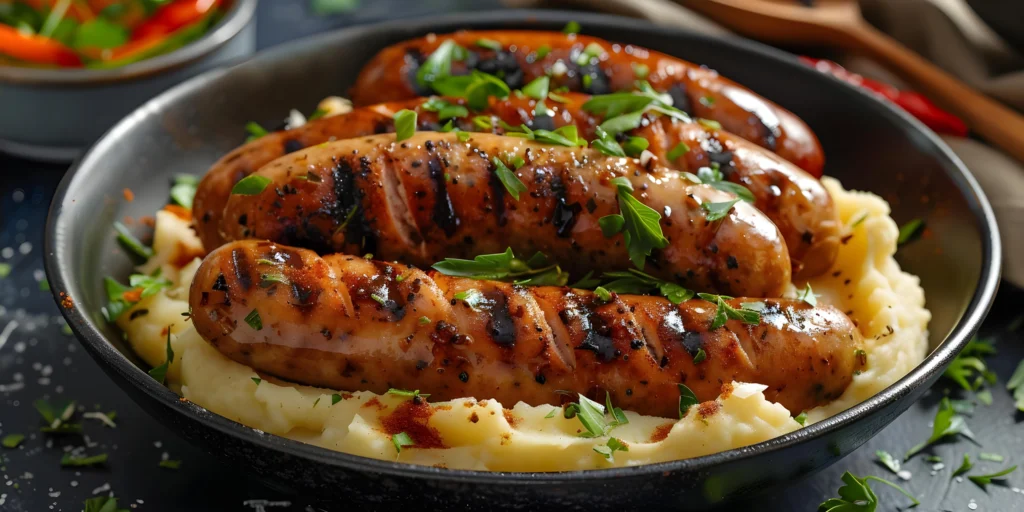
- Color: Outside is golden brown to dark brown when pan-fried; inside remains pinkish to light brown, depending on the cooking level.
- Shape: Typically cylindrical, but can vary based on how it’s prepared (links, patties, or bulk).
- Size: Varies widely; links are commonly about 4-6 inches long and about an inch in diameter.
- Texture: Firm and slightly coarse, with a juicy interior when cooked properly.
Culinary Uses
Mild Italian pork sausage is versatile in the kitchen:
- Common Dishes: Used in pasta sauces, pizza toppings, in stews, as part of a mixed grill, in sandwiches, and as a breakfast protein.
- Preparation Methods: Can be pan-fried, grilled, baked, or broiled. Often cooked whole in links, but can also be removed from the casing and cooked as ground meat.
- Suitable Pairings: Pairs well with tomato-based sauces, peppers, onions, and hearty vegetables. Complements a wide range of herbs and spices, especially Italian seasoning.
Geographical Information
- Origin: Italian sausage, as its name implies, has its roots in Italian cuisine, with various regions of Italy having their own specific recipes and uses for this type of sausage.
- Primary Growing Regions: Pork, the main ingredient, is widely produced in countries such as China, the European Union, the United States, and Brazil.
- Seasonal Availability: Available year-round due to the widespread production of pork and the availability of commercial sausage-making operations.
Mild Italian pork sausage is a flavorful and rich source of protein, popular in many dishes for its savory and slightly sweet taste. While it provides certain essential nutrients, it is also high in fats and calories, making moderation key for those monitoring their dietary intake.
| Proximates: | |
| Water | 50.9 g |
| Energy (Atwater General Factors) | 317 kcal |
| Energy (Atwater Specific Factors) | 322 kcal |
| Nitrogen | 2.91 g |
| Protein | 18.2 g |
| Total lipid (fat) | 26.2 g |
| Total fat (NLEA) | 25.8 g |
| Ash | 2.63 g |
| Carbohydrates: | |
| Carbohydrate, by difference | 2.15 g |
| Sugars, Total | 1.46 g |
| Glucose | 1.46 g |
| Minerals: | |
| Calcium, Ca | 12 mg |
| Iron, Fe | 1.29 mg |
| Magnesium, Mg | 18.6 mg |
| Phosphorus, P | 145 mg |
| Potassium, K | 310 mg |
| Sodium, Na | 766 mg |
| Zinc, Zn | 2.41 mg |
| Copper, Cu | 0.074 mg |
| Manganese, Mn | 0.033 mg |
| Selenium, Se | 20.2 µg |
| Vitamins and Other Components: | |
| Thiamin | 0.31 mg |
| Riboflavin | 0.242 mg |
| Niacin | 5.73 mg |
| Pantothenic acid | 0.783 mg |
| Vitamin B-6 | 0.343 mg |
| Folate, total | 0 µg |
| Choline, total | 70.4 mg |
| Choline, free | 5.9 mg |
| Choline, from phosphocholine | 46.1 mg |
| Choline, from phosphatidylcholine | 0.3 mg |
| Choline, from glycerophosphocholine | 10.5 mg |
| Choline, from sphingomyelin | 7.6 mg |
| Betaine | 3.9 mg |
| Vitamin B-12 | 1.06 µg |
| Vitamin A, RAE | 22 µg |
| Retinol | 22 µg |
| Vitamin E (alpha-tocopherol) | 0.8 mg |
| Tocopherol, gamma | 0.15 mg |
| Vitamin K (Menaquinone-4) | 18.8 µg |
| Lipids: | |
| Fatty acids, total saturated | 9.15 g |
| SFA 4:0 | 0.006 g |
| SFA 8:0 | 0.002 g |
| SFA 10:0 | 0.016 g |
| SFA 12:0 | 0.017 g |
| SFA 14:0 | 0.335 g |
| SFA 15:0 | 0.012 g |
| SFA 16:0 | 5.71 g |
| SFA 17:0 | 0.069 g |
| SFA 18:0 | 2.9 g |
| SFA 20:0 | 0.065 g |
| SFA 22:0 | 0.01 g |
| Fatty acids, total monounsaturated | 11.6 g |
| MUFA 14:1 c | 0.005 g |
| MUFA 16:1 c | 0.576 g |
| MUFA 17:1 | 0.056 g |
| MUFA 17:1 c | 0.056 g |
| MUFA 18:1 c | 10.7 g |
| MUFA 20:1 c | 0.297 g |
| MUFA 22:1 c | 0.009 g |
| MUFA 22:1 n-9 | 0.009 g |
| Fatty acids, total polyunsaturated | 4.96 g |
| PUFA 18:2 c | 4.34 g |
| PUFA 18:2 n-6 c,c | 4.31 g |
| PUFA 18:2 CLAs | 0.029 g |
| PUFA 18:3 c | 0.18 g |
| PUFA 18:3 n-3 c,c,c (ALA) | 0.175 g |
| PUFA 18:3 n-6 c,c,c | 0.005 g |
| PUFA 20:2 c | 0.217 g |
| PUFA 20:2 n-6 c,c | 0.217 g |
| PUFA 20:3 c | 0.063 g |
| PUFA 20:3 n-3 | 0.027 g |
| PUFA 20:3 n-6 | 0.036 g |
| PUFA 20:4 | 0.125 g |
| PUFA 20:4c | 0.125 g |
| PUFA 20:5c | 0.005 g |
| PUFA 20:5 n-3 (EPA) | 0.005 g |
| PUFA 22:2 | 0.003 g |
| PUFA 22:5 c | 0.024 g |
| PUFA 22:4 | 0.046 g |
| PUFA 22:5 n-3 (DPA) | 0.024 g |
| PUFA 22:6 c | 0.003 g |
| PUFA 22:6 n-3 (DHA) | 0.003 g |
| Fatty acids, total trans | 0.1 g |
| Fatty acids, total trans-monoenoic | 0.079 g |
| TFA 16:1 t | 0.007 g |
| TFA 18:1 t | 0.073 g |
| Fatty acids, total trans-dienoic | 0.02 g |
| TFA 18:2 t not further defined | 0.02 g |
| Cholesterol | 80 mg |