
Basic Information
- Common Name: Sunflower Seed Kernels, Dry Roasted with Salt Added
- Scientific Name: Helianthus annuus
- Category: Seeds/Nuts
- Varieties: While there aren’t specific varieties of dry-roasted sunflower seed kernels, sunflower seeds themselves come from different species of sunflowers, some cultivated for their oil-rich seeds, others for snacking seeds, and some for bird feed.
Nutritional Information
- Macronutrients (per 1 ounce, about 28 grams):
- Carbohydrates: Approximately 14-17 grams, including dietary fiber around 3 grams.
- Proteins: About 21 grams.
- Fats: 56.3 grams, mostly unsaturated fats (polyunsaturated and monounsaturated fats).
- Micronutrients: Rich in vitamin E, B vitamins (especially niacin, B6, and folate), magnesium, selenium, phosphorus, copper, and manganese. The salt addition increases the sodium content.
- Calorie Count: Roughly 165 calories per ounce.
- Glycemic Index: Low; sunflower seeds have minimal impact on blood sugar levels.
Phytonutrients
Sunflower seed kernels, especially when dry roasted with salt added, are a nutritious snack packed with a variety of beneficial compounds, including essential nutrients and phytonutrients. These components contribute to the seeds’ health-promoting properties. Here’s an overview of the key phytonutrients found in dry roasted sunflower seed kernels:
1. Vitamin E (Tocopherols)
- Type: A group of fat-soluble compounds known for their antioxidant properties.
- Benefits: Vitamin E acts as a powerful antioxidant, protecting cells from oxidative damage. It’s crucial for skin health, immune function, and preventing inflammation.
2. Phytosterols
- Type: Plant compounds structurally similar to cholesterol.
- Benefits: Phytosterols can help lower LDL cholesterol levels in the blood, reducing the risk of heart disease. They also exhibit anti-inflammatory properties.
3. Phenolic Acids and Flavonoids
- Type: Includes chlorogenic acid, quinic acid, and caffeic acid.
- Benefits: These compounds have antioxidant properties, which can help protect against cellular damage and reduce the risk of chronic diseases.
4. Linoleic Acid (Omega-6 Fatty Acid)
- Type: A type of polyunsaturated fatty acid.
- Benefits: Essential for human health, linoleic acid is involved in cell structure and function, and it plays a role in inflammatory processes and immune response.
5. Beta-sitosterol
- Type: A specific phytosterol found in sunflower seeds.
- Benefits: Apart from lowering cholesterol, beta-sitosterol has been associated with supporting prostate health and boosting the immune system.
6. Magnesium and Selenium
- Type: Essential minerals, not phytonutrients, but noteworthy for their roles in supporting health.
- Benefits: Magnesium is vital for nerve function, muscle contractions, and energy production, while selenium has antioxidant properties and is important for thyroid function and immune health.
While sunflower seed kernels are not typically highlighted for their phytonutrient content in the way fruits and vegetables are, they do offer a range of bioactive compounds that can contribute to overall health and well-being. Including dry roasted sunflower seed kernels in your diet can provide essential fatty acids, antioxidants, and other beneficial compounds, supporting heart health, reducing inflammation, and potentially lowering the risk of chronic diseases.
Physical Characteristics
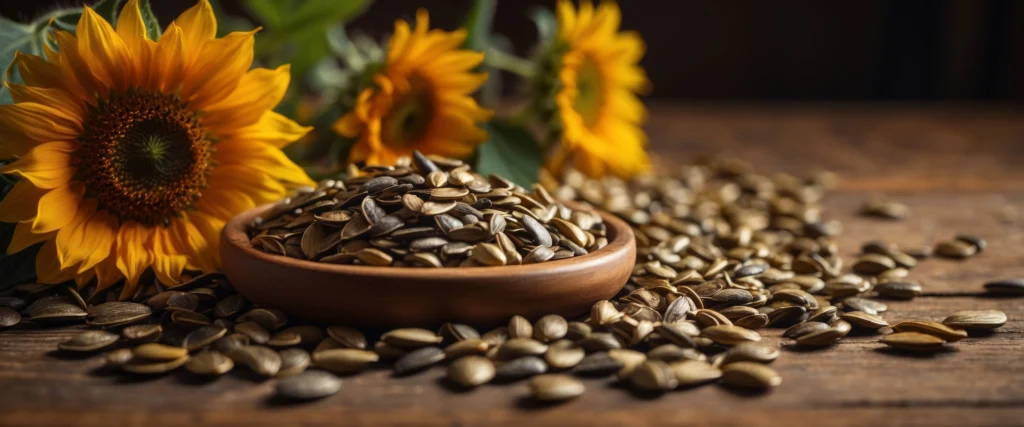
- Color: Light grey to greenish or creamy white, depending on the hull removal process.
- Shape: Teardrop-shaped to somewhat rounded.
- Size: Typically about 1 cm in length.
- Texture: Crunchy, with a slightly oily touch due to the natural fat content, becoming more pronounced after roasting.
Culinary Uses
- Common Dishes: Eaten as a snack on their own, added to trail mixes, sprinkled over salads, incorporated into baked goods like bread and muffins, or used as a topping for yogurt and oatmeal.
- Preparation Methods: These kernels are already dry-roasted and ready to eat. They can also be ground into sunflower seed butter or used as an ingredient in various recipes.
- Suitable Pairings: Pairs well with dried fruits in trail mixes, complements the creaminess of cheeses and yogurts, and works well with the sweetness of chocolate and other baked treats.
Geographical Information
- Origin: Sunflowers are native to North America and have been cultivated by indigenous peoples for thousands of years.
- Primary Growing Regions: Major producers include Russia, Ukraine, and the United States, with significant cultivation also in Argentina, China, and Turkey.
- Seasonal Availability: Sunflower seeds are harvested in late summer and early fall, but dry-roasted kernels are available year-round.
Dry-roasted sunflower seed kernels with salt added to offer a tasty and nutritious snack option or ingredient, providing essential nutrients and healthful fats. Their wide availability and versatile culinary uses make them a staple in many diets worldwide, enjoyed for both their flavor and nutritional benefits.
| Proximates: | |
| Water | 1.5 g |
| Energy (Atwater General Factors) | 657 kcal |
| Energy (Atwater Specific Factors) | 612 kcal |
| Nitrogen | 3.96 g |
| Protein | 21 g |
| Total lipid (fat) | 56.1 g |
| Total fat (NLEA) | 52.1 g |
| Ash | 4.3 g |
| Carbohydrates: | |
| Carbohydrate, by difference | 17.1 g |
| Carbohydrate, by summation | 14.9 g |
| Fiber, total dietary | 10.3 g |
| Sugars, Total | 3.14 g |
| Sucrose | 3.14 g |
| Glucose | 0 g |
| Fructose | 0 g |
| Lactose | 0 g |
| Starch | 1.5 g |
| Minerals: | |
| Calcium, Ca | 78 mg |
| Iron, Fe | 5.21 mg |
| Magnesium, Mg | 358 mg |
| Phosphorus, P | 750 mg |
| Potassium, K | 689 mg |
| Sodium, Na | 532 mg |
| Zinc, Zn | 6 mg |
| Copper, Cu | 1.83 mg |
| Manganese, Mn | 2.89 mg |
| Selenium, Se | 80.4 |
| Vitamins and Other Components: | |
| Thiamin | 0.473 mg |
| Riboflavin | 0.507 mg |
| Niacin | 6.96 mg |
| Pantothenic acid | 0.84 mg |
| Vitamin B-6 | 0.76 mg |
| Folate, total | 169 |
| Choline, total | 52 mg |
| Choline, free | 6.9 mg |
| Choline, from phosphocholine | 41.7 mg |
| Choline, from phosphotidyl choline | 0.5 mg |
| Choline, from glycerophosphocholine | 3 mg |
| Betaine | 8.7 mg |
| Vitamin A, RAE | 1 |
| Carotene, beta | 10 |
| Cryptoxanthin, beta | 1 |
| Lutein + zeaxanthin | 42 |
| Vitamin E (alpha-tocopherol) | 19.6 mg |
| Tocopherol, beta | 0.99 mg |
| Tocopherol, gamma | 0.97 mg |
| Tocopherol, delta | 0.33 mg |
| Tocotrienol, alpha | 0.05 mg |
| Vitamin K (phylloquinone) | 1.2 |
| Vitamin K (Dihydrophylloquinone) | 1.4 |
| Lipids: | |
| Fatty acids, total saturated | 5.36 g |
| SFA 14:0 | 0.022 g |
| SFA 15:0 | 0.009 g |
| SFA 16:0 | 2.26 g |
| SFA 17:0 | 0.026 g |
| SFA 18:0 | 2.14 g |
| SFA 20:0 | 0.182 g |
| SFA 22:0 | 0.543 g |
| SFA 24:0 | 0.184 g |
| Fatty acids, total monounsaturated | 33.4 g |
| MUFA 16:1 c | 0.029 g |
| MUFA 17:1 | 0.026 g |
| MUFA 17:1 c | 0.026 g |
| MUFA 18:1 c | 32.2 g |
| MUFA 20:1 c | 0.146 g |
| MUFA 22:1 c | 0.002 g |
| MUFA 22:1 n-9 | 0.002 g |
| MUFA 24:1 c | 0.007 g |
| Fatty acids, total polyunsaturated | 13 g |
| PUFA 18:2 c | 13 g |
| PUFA 18:2 n-6 c,c | 13 g |
| PUFA 18:2 CLAs | 0.006 g |
| PUFA 18:3 c | 0.061 g |
| PUFA 18:3 n-3 c,c,c (ALA) | 0.059 g |
| PUFA 18:3 n-6 c,c,c | 0.002 g |
| PUFA 20:4 | 0.02 g |
| PUFA 20:4c | 0.02 g |
| PUFA 22:2 | 0.005 g |
| Fatty acids, total trans | 0.297 g |
| Fatty acids, total trans-monoenoic | 0.213 g |
| TFA 18:1 t | 0.213 g |
| Fatty acids, total trans-dienoic | 0.084 g |
| TFA 18:2 t not further defined | 0.084 g |