

Basic Information
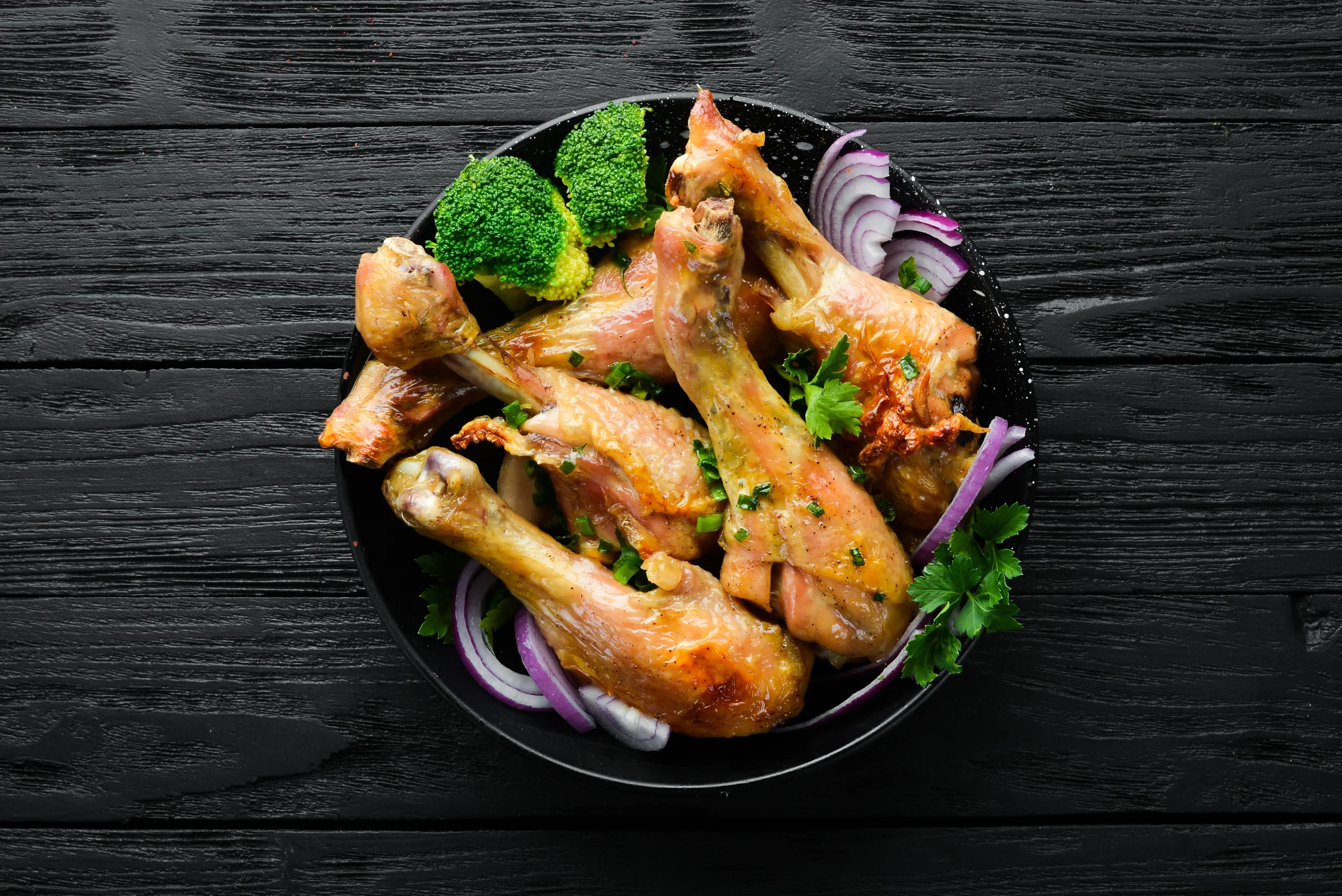
Name (Common): Chicken Drumstick (Meat Only, Cooked, Braised)
Scientific: Gallus gallus domesticus
Category: Poultry, Meat
Varieties: While the primary distinction in chicken meat comes from the part of the bird (e.g., breast, thigh, drumstick), variations in nutritional content and flavor can arise from the breed of chicken, its diet, and how it was raised (e.g., organic, free-range, conventional).
Nutritional Information
Macronutrients
- Carbohydrates: Negligible; chicken meat does not contain carbohydrates.
- Proteins: High, about 23.9 grams per 100 grams, providing a rich source of complete protein with all essential amino acids.
- Fats: Moderate, approximately 5.95 grams per 100 grams, with a mix of saturated and unsaturated fats. The fat content can vary based on cooking methods and whether additional fats are used.
Micronutrients
Vitamin B6: Important for protein metabolism and the creation of neurotransmitters.
Niacin (Vitamin B3): Essential for the metabolism of food into energy.
Selenium: An antioxidant that supports immune function and thyroid health.
Phosphorus: Crucial for bone health and maintaining various bodily functions.
Phytonutrients
Chicken, including the drumstick portion from broilers or fryers, when cooked and braised, is primarily a significant source of macronutrients (such as proteins and fats) and essential micronutrients (including vitamins and minerals), rather than phytonutrients. Phytonutrients are naturally occurring compounds found in plants that have health-promoting properties, including antioxidants, anti-inflammatory agents, and others contributing to various health benefits. Since chicken is an animal product, it does not contain phytonutrients.
However, chicken, particularly the drumstick portion, is rich in various bioactive compounds and nutrients that contribute to its nutritional profile:
Nutritional Compounds in Chicken Drumsticks
Proteins: High-quality, complete proteins that contain all essential amino acids necessary for muscle growth, repair, and overall bodily functions.
B Vitamins: Chicken drumsticks are a good source of several B vitamins, particularly Vitamin B6 and Niacin (B3), which are essential for energy metabolism, maintaining healthy nerve function, and synthesizing neurotransmitters.
Minerals:
Selenium: An essential mineral with antioxidant properties, crucial for immune function and thyroid health.
Phosphorus: Important for the formation of bones and teeth, as well as playing a role in how the body uses carbohydrates and fats.
Iron: Necessary for the formation of hemoglobin, which carries oxygen in the blood.
Health Benefits
While not phytonutrients, the nutrients found in chicken drumsticks contribute to several health benefits:
Muscle Maintenance and Growth: The high protein content supports the maintenance and growth of muscle mass, which is vital for overall health and metabolism.
Metabolic Health: B vitamins play a critical role in metabolic processes, including converting food into energy and synthesizing important molecules.
Antioxidant Support: Selenium acts as an antioxidant, helping to reduce oxidative stress and may protect against some diseases.

Considerations
Including chicken drumsticks in a balanced diet can provide essential nutrients beneficial for health. However, it’s important to balance animal protein intake with a variety of plant-based foods, which are rich in phytonutrients and fiber, to ensure a comprehensive nutritional profile and health benefits.
In summary, while chicken drumsticks do not contain phytonutrients, they offer a rich source of other important nutrients, making them a nutritious option for inclusion in a balanced diet.
Calorie Count and Glycemic Index
- Calorie Count: About 175-200 calories per 100 grams, depending on the cooking method and the chicken’s fat content.
- Glycemic Index: Not applicable, as it contains no carbohydrates.
Physical Characteristics
Color: The cooked meat is white to off-white, with darker areas near the bone and where the meat is more densely packed.
Shape: The drumstick is cylindrical, tapering down to the bone at one end.
Size: Typically ranges from 90 to 130 grams (3.2 to 4.6 ounces) per drumstick, including the bone.
Texture: Tender and moist when braised properly, with a fibrous, slightly stringy nature typical of leg meat.
Culinary Uses
Common Dishes: Braised chicken drumsticks are used in stews, soups, and standalone entrees, often accompanied by rich sauces or gravies.
Preparation Methods: Braising involves cooking the drumsticks slowly in a small amount of liquid, resulting in tender and flavorful meat.
Suitable Pairings: Pairs well with a variety of herbs and spices, root vegetables, grains like rice and quinoa, and legumes.
Geographical Information
Origin: Chickens were domesticated thousands of years ago in Southeast Asia and have since become a staple meat source worldwide.
Primary Growing Regions: Chicken farming is global, with significant production in the United States, China, Brazil, and many European countries.
Seasonal Availability: Available year-round due to controlled poultry farming practices that ensure a constant supply of chicken meat.
Chicken drumsticks, especially when cooked and braised, offer a flavorful and nutritious option for meat consumption. Their rich protein content, along with essential vitamins and minerals, makes them a valuable part of a balanced diet. The braising process, which involves slow cooking in liquid, ensures that the drumsticks remain moist and tender, enhancing their natural flavor and making them a popular choice for a variety of dishes.
| Proximates: | |
| Water | 69.9 g |
| Energy (Atwater General Factors) | 149 kcal |
| Energy (Atwater Specific Factors) | 156 kcal |
| Nitrogen | 3.83 g |
| Protein | 23.9 g |
| Total lipid (fat) | 5.95 g |
| Total fat (NLEA) | 5.23 g |
| Ash | 0.98 g |
| Carbohydrates: | |
| Carbohydrate, by difference | 0 g |
| Minerals: | |
| Calcium, Ca | 12 mg |
| Iron, Fe | 0.94 mg |
| Magnesium, Mg | 22.4 mg |
| Phosphorus, P | 184 mg |
| Potassium, K | 239 mg |
| Sodium, Na | 117 mg |
| Zinc, Zn | 2.54 mg |
| Copper, Cu | 0.063 mg |
| Manganese, Mn | 0.018 mg |
| Selenium, Se | 27.9 µg |
| Vitamins and Other Components: | |
| Thiamin | 0.088 mg |
| Riboflavin | 0.18 mg |
| Niacin | 5.05 mg |
| Pantothenic acid | 1.1 mg |
| Vitamin B-6 | 0.372 mg |
| Vitamin B-12 | 0.41 µg |
| Vitamin A, RAE | 7 µg |
| Retinol | 7 µg |
| Vitamin E (alpha-tocopherol) | 0.17 mg |
| Tocopherol, gamma | 0.08 mg |
| Tocotrienol, alpha | 0.01 mg |
| Tocotrienol, gamma | 0.05 mg |
| Vitamin D (D2 + D3), International Units | 2 IU |
| Vitamin D (D2 + D3) | 0.1 µg |
| Vitamin D3 (cholecalciferol) | 0.1 µg |
| Lipids: | |
| Fatty acids, total saturated | 1.6 g |
| SFA 4:0 | 0.001 g |
| SFA 6:0 | 0.001 g |
| SFA 8:0 | 0.002 g |
| SFA 12:0 | 0.003 g |
| SFA 14:0 | 0.03 g |
| SFA 15:0 | 0.005 g |
| SFA 16:0 | 1.2 g |
| SFA 17:0 | 0.006 g |
| SFA 18:0 | 0.346 g |
| SFA 20:0 | 0.004 g |
| SFA 22:0 | 0.007 g |
| Fatty acids, total monounsaturated | 2.35 g |
| MUFA 14:1 c | 0.012 g |
| MUFA 16:1 c | 0.371 g |
| MUFA 17:1 | 0.003 g |
| MUFA 17:1 c | 0.003 g |
| MUFA 18:1 c | 1.94 g |
| MUFA 20:1 | 0.023 g |
| MUFA 20:1 c | 0.023 g |
| MUFA 24:1 c | 0.002 g |
| Fatty acids, total polyunsaturated | 1.24 g |
| PUFA 18:2 c | 1.06 g |
| PUFA 18:2 n-6 c,c | 1.05 g |
| PUFA 18:2 CLAs | 0.006 g |
| PUFA 18:3 c | 0.055 g |
| PUFA 18:3 n-3 c,c,c (ALA) | 0.045 g |
| PUFA 18:3 n-6 c,c,c | 0.01 g |
| PUFA 20:2 c | 0.01 g |
| PUFA 20:2 n-6 c,c | 0.01 g |
| PUFA 20:3 c | 0.019 g |
| PUFA 20:3 n-6 | 0.019 g |
| PUFA 20:4 | 0.088 g |
| PUFA 20:4c | 0.088 g |
| PUFA 20:5c | 0.004 g |
| PUFA 20:5 n-3 (EPA) | 0.004 g |
| PUFA 22:5 c | 0.008 g |
| PUFA 22:4 | 0.022 g |
| PUFA 22:5 n-3 (DPA) | 0.008 g |
| PUFA 22:6 c | 0.005 g |
| PUFA 22:6 n-3 (DHA) | 0.005 g |
| Fatty acids, total trans | 0.03 g |
| Fatty acids, total trans-monoenoic | 0.021 g |
| TFA 16:1 t | 0.003 g |
| TFA 18:1 t | 0.018 g |
| Fatty acids, total trans-dienoic | 0.008 g |
| TFA 18:2 t not further defined | 0.008 g |
| Cholesterol | 127 mg |