

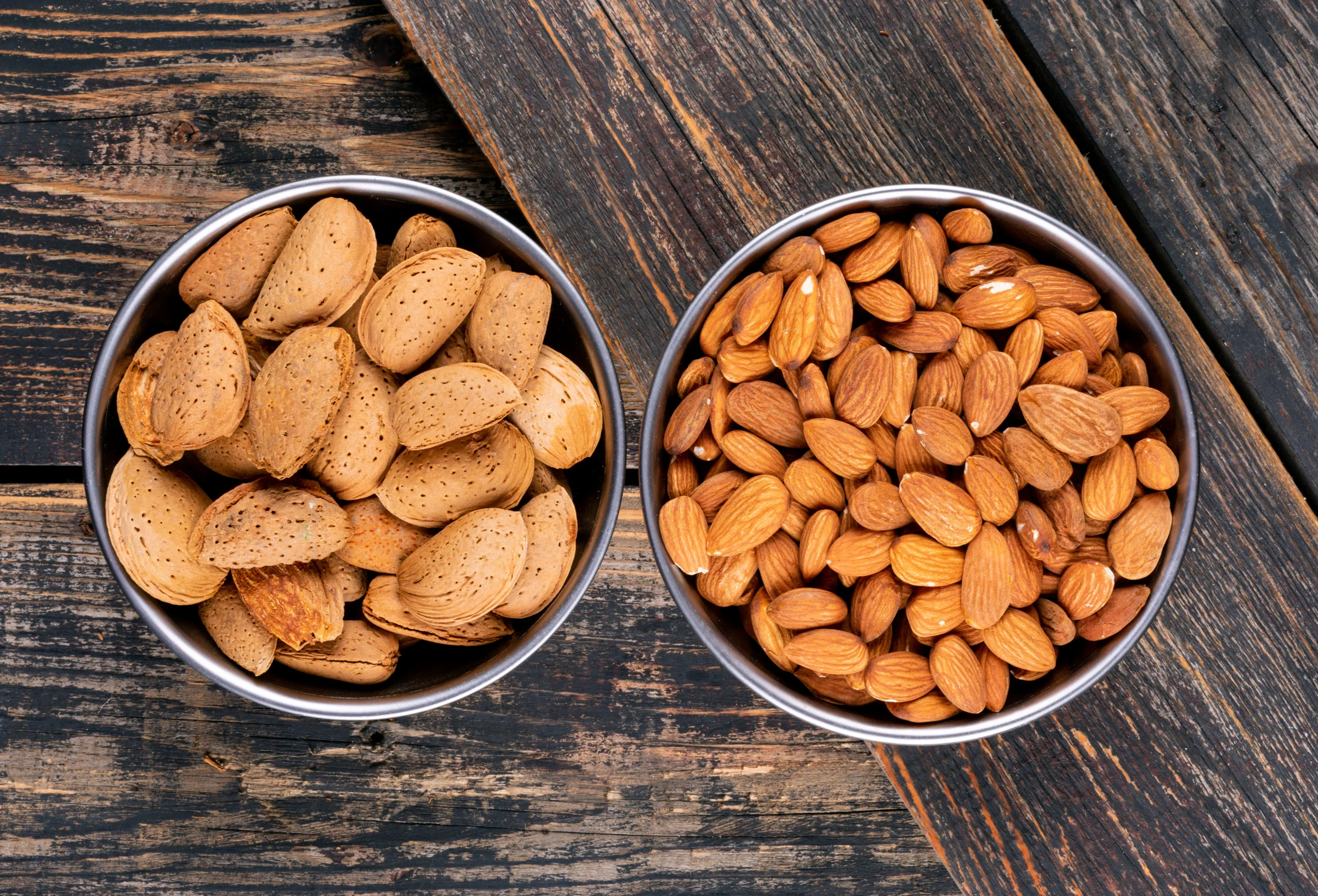
Basic Information
- Common Name: Almonds, dry roasted with salt added
- Scientific Name: Prunus dulcis
- Category: Nut
Varieties
While the focus here is on dry roasted almonds with salt added, it’s worth noting that almonds come in various forms: raw, blanched, slivered, and flavored varieties. The primary difference in the varieties comes from how they are processed and prepared rather than different species of almond trees.
Nutritional Information
Macronutrients (per 100g of dry roasted almonds with salt added)
- Carbohydrates: Approximately 16.2g
- Proteins: About 20.4g
- Fats: 57.8g
Micronutrients
Dry roasted almonds are rich in vitamins and minerals, including:
- Vitamins: Vitamin E (a potent antioxidant), riboflavin (vitamin B2), and niacin (vitamin B3).
- Minerals: Magnesium, phosphorus, potassium, calcium, iron, and zinc.
Phytonutrients
Almonds, including dry roasted varieties with salt added, are not only nutritious due to their vitamins and minerals but also because they contain various phytonutrients. These compounds offer numerous health benefits, such as antioxidant properties, reduced inflammation, and potential protection against certain diseases. Here’s a closer look at the phytonutrients present in almonds:
Phenolic Acids
- Hydroxybenzoic acids and Hydroxycinnamic acids: These compounds have antioxidant properties, helping to protect the body’s cells from oxidative stress and reduce inflammation.
Flavonoids
- Catechins, Epicatechins, and Isorhamnetin: Found in the skin of almonds, these flavonoids possess strong antioxidant and anti-inflammatory properties. They can help lower the risk of chronic conditions such as heart disease and diabetes.
Tannins
- Condensed tannins (proanthocyanidins): Present in almond skins, tannins have antioxidant effects and contribute to the bitter taste of the skin. They can help with cardiovascular health and have antimicrobial properties.
Other Phytochemicals
- Phytosterols: Almonds are a good source of phytosterols, especially beta-sitosterol, which can help lower cholesterol levels by reducing cholesterol absorption in the intestines.
Vitamin E (Tocopherols)
- Although not exclusively classified as a phytonutrient, vitamin E is a fat-soluble antioxidant found abundantly in almonds. It helps protect cell membranes from oxidative damage and supports skin health and immune function.
Dietary Fiber
- While dietary fiber is typically not categorized under phytonutrients, the fiber in almonds aids in digestive health, helps maintain blood sugar levels, and contributes to satiety, which can assist in weight management.
It’s important to note that the process of dry roasting and adding salt may slightly alter the levels of these phytonutrients compared to raw almonds, but they still remain a nutritious option. Consuming almonds as part of a balanced diet can contribute to overall health and well-being by providing these beneficial compounds.
Calorie Count
There are about 621 calories per 100 grams of dry roasted almonds.
Glycemic Index
Almonds have a low glycemic index (GI) of around 0-5, making them a good option for blood sugar management.
Physical Characteristics
- Color: Golden brown, depending on the degree of roasting.
- Shape: Almonds are typically elongated and slightly curved with a pointed tip.
- Size: Each almond is about 1 to 1.5 inches (2.5 to 3.8 cm) long.
- Texture: Dry roasted almonds have a crunchy texture with a slightly oily feel due to their natural fat content.
Culinary Uses
Dry roasted almonds with salt added are versatile in culinary uses:
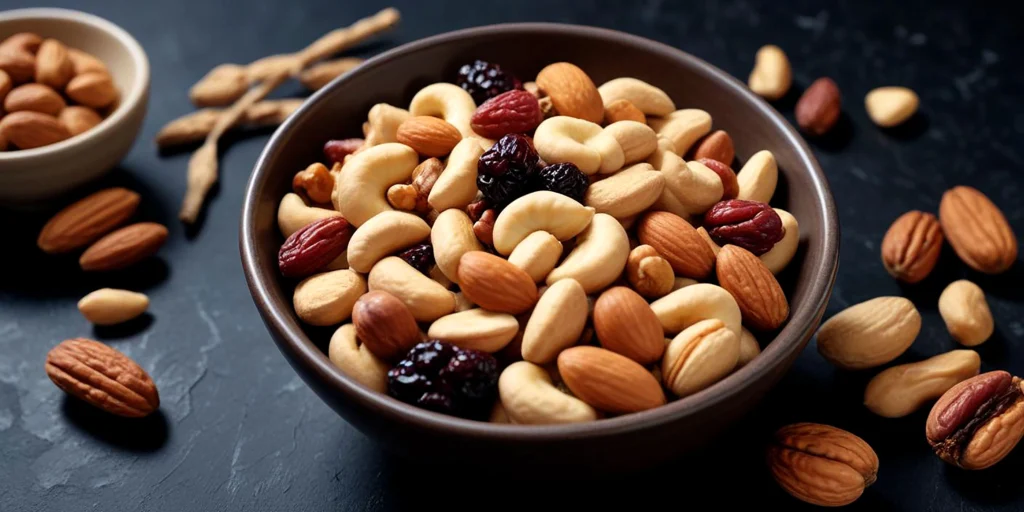
- Common Dishes: Eaten as a snack on their own, included in trail mixes, or used as a topping for salads and yogurts.
- Preparation Methods: Beyond the dry roasting process, almonds can be used in baking, ground into almond flour for gluten-free recipes, or made into almond butter.
- Suitable Pairings: They pair well with fruits, cheeses, chocolate, and are often used in Middle Eastern and Mediterranean cuisines.
Geographical Information
- Origin: The almond tree is native to the Middle East, India, and North Africa.
- Primary Growing Regions: Today, the United States (particularly California) is the largest producer of almonds. Other significant producers include Spain, Iran, Morocco, and Italy.
- Seasonal Availability: Almonds are harvested in late summer, but dry roasted almonds with salt added are available year-round due to processing and storage capabilities.
| proximates: | |
| Water | 2.2 g |
| Energy (Atwater General Factors) | 667 kcal |
| Energy (Atwater Specific Factors) | 621 kcal |
| Nitrogen | 3.94 g |
| Protein | 20.4 g |
| Total lipid (fat) | 57.8 g |
| Ash | 3.47 g |
| Carbohydrates: | |
| Carbohydrate, by difference | 16.2 g |
| Fiber, total dietary | 11 g |
| Sugars, Total | 4.17 g |
| Sucrose | 4.17 g |
| Minerals: | |
| Calcium, Ca | 273 mg |
| Iron, Fe | 3.17 mg |
| Magnesium, Mg | 258 mg |
| Phosphorus, P | 456 mg |
| Potassium, K | 684 mg |
| Sodium, Na | 256 mg |
| Zinc, Zn | 2.8 mg |
| Copper, Cu | 0.87 mg |
| Manganese, Mn | 2.02 mg |
| Vitamins and Other Components: | |
| Thiamin | 0.079 mg |
| Riboflavin | 1.57 mg |
| Niacin | 3.1 mg |
| Pantothenic acid | 0.237 mg |
| Vitamin B-6 | 0.075 mg |
| Folate, total | 35 µg |
| Choline, total | 60.8 mg |
| Choline, free | 4.3 mg |
| Choline, from phosphocholine | 56.1 mg |
| Choline, from glycerophosphocholine | 0.4 mg |
| Vitamin A, RAE | 2 µg |
| Carotene, beta | 17 µg |
| Cryptoxanthin, beta | 9 µg |
| Lutein + zeaxanthin | 25 µg |
| Vitamin E (alpha-tocopherol) | 19 mg |
| Tocopherol, beta | 0.18 mg |
| Tocopherol, gamma | 0.92 mg |
| Tocotrienol, alpha | 0.28 mg |
| Lipids: | |
| Fatty acids, total saturated | 4.56 g |
| SFA 4:0 | 0.001 g |
| SFA 14:0 | 0.027 g |
| SFA 15:0 | 0.008 g |
| SFA 16:0 | 3.54 g |
| SFA 17:0 | 0.028 g |
| SFA 18:0 | 0.828 g |
| SFA 20:0 | 0.059 g |
| SFA 22:0 | 0.042 g |
| SFA 24:0 | 0.024 g |
| Fatty acids, total monounsaturated | 34.2 g |
| MUFA 16:1 c | 0.259 g |
| MUFA 17:1 | 0.061 g |
| MUFA 17:1 c | 0.061 g |
| MUFA 18:1 c | 33.8 g |
| MUFA 20:1 c | 0.076 g |
| MUFA 22:1 c | 0.001 g |
| MUFA 22:1 n-9 | 0.001 g |
| MUFA 24:1 c | 0.001 g |
| Fatty acids, total polyunsaturated | 14.5 g |
| PUFA 18:2 c | 14.5 g |
| PUFA 18:2 n-6 c,c | 14.5 g |
| PUFA 18:2 CLAs | 0.006 g |
| PUFA 18:3 c | 0.052 g |
| PUFA 18:3 n-3 c,c,c (ALA) | 0.05 g |
| PUFA 18:3 n-6 c,c,c | 0.002 g |
| PUFA 20:4 | 0.005 g |
| PUFA 20:4c | 0.005 g |
| PUFA 20:5c | 0.002 g |
| PUFA 20:5 n-3 (EPA) | 0.002 g |
| Fatty acids, total trans | 0.032 g |
| Fatty acids, total trans-monoenoic | 0.016 g |
| TFA 18:1 t | 0.016 g |
| Fatty acids, total trans-dienoic | 0.016 g |
| TFA 18:2 t not further defined | 0.016 g |