

Basic Information
- Common Name: Pecans
- Scientific Name: Carya illinoinensis
- Category: Nut
Varieties
Pecans come in numerous varieties, which can vary in size, flavor, and shell thickness. Some popular varieties include ‘Stuart’, ‘Desirable’, ‘Moreland’, and ‘Cape Fear’. The differences among these varieties can affect their suitability for certain culinary uses, though they are often interchangeable in recipes.
Nutritional Information
Macronutrients (per 100g of raw pecan halves)
- Carbohydrates: Approximately 12.7g
- Proteins: About 9.96g
- Fats: 73.3g
Micronutrients
Raw pecans are a good source of several vitamins and minerals, notably:
- Vitamins: High in Vitamin E, B vitamins (especially B1, B6), and folate.
- Minerals: Rich in Magnesium, Phosphorus, Zinc, and particularly high in Manganese.
Phytonutrients
Raw pecan halves are not just a tasty addition to a variety of dishes; they’re also packed with beneficial phytonutrients that contribute to their health-promoting properties. These compounds include antioxidants, vitamins, and minerals that support heart health, reduce inflammation, and may lower the risk of certain diseases. Here’s a detailed look at the key phytonutrients found in raw pecan halves:
Antioxidants
- Vitamin E (Tocopherols): Pecans are a good source of vitamin E, an antioxidant that protects cells from oxidative damage and supports skin health and immune function.
- Flavonoids: These plant-based compounds have antioxidant properties that can help neutralize free radicals, reducing oxidative stress and potentially lowering the risk of chronic diseases.
Phenolic Compounds
- Ellagic Acid: This polyphenol has antioxidant and anti-inflammatory properties. It’s been studied for its potential to prevent cancer and fight against viral and bacterial infections.
- Gallic Acid and Tannins: Gallic acid, often in the form of tannins, has strong antioxidant properties. It may contribute to the anticancer, antimicrobial, and anti-inflammatory potential of pecans.
Phytosterols
- Beta-Sitosterol: Pecans are rich in phytosterols, particularly beta-sitosterol, which may help lower cholesterol levels by reducing intestinal cholesterol absorption, thereby supporting heart health.
Fatty Acids
- Monounsaturated Fats (Oleic Acid): The primary fat in pecans is oleic acid, a heart-healthy monounsaturated fat that can help reduce LDL (bad) cholesterol levels and increase HDL (good) cholesterol levels.
- Polyunsaturated Fats (Linoleic Acid): Pecans also contain linoleic acid, an omega-6 fatty acid that is essential for health and must be obtained through the diet.
Minerals with Antioxidant Properties
- Magnesium: An essential mineral for over 300 biochemical reactions in the body, magnesium supports heart health, bone health, and diabetes management. It also plays a role in reducing oxidative stress.
- Zinc: This mineral is vital for immune function, wound healing, DNA synthesis, and cell division. Zinc also acts as an antioxidant, helping to fight oxidative stress.
Dietary Fiber
- Fiber: Although not a phytonutrient, the dietary fiber in pecans is beneficial for digestive health, helps maintain stable blood sugar levels, and contributes to satiety, which might aid in weight management.
The combination of these phytonutrients in pecans contributes to their numerous health benefits, making them a valuable addition to a balanced diet. However, due to their high calorie and fat content, it’s important to consume pecans in moderation.
Calorie Count
There are about 700 calories per 100 grams of raw pecan halves.
Glycemic Index
Pecans have a low glycemic index (GI), estimated to be very low due to their high fat and low carbohydrate content, making them a good option for blood sugar management.
Physical Characteristics
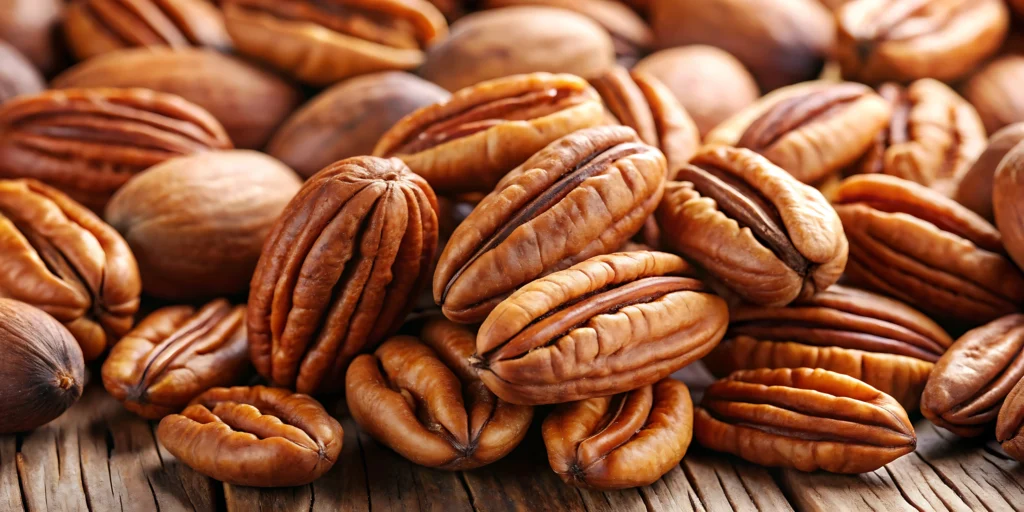
- Color: Golden brown with a darker brown stripe running through the center of each half.
- Shape: Oblong and slightly curved with a smooth, ridged surface.
- Size: Pecan halves can vary in size but typically are about 1 to 2 inches (2.5 to 5 cm) long.
- Texture: Firm and crunchy with a buttery, oily feel.
Culinary Uses
Pecans are versatile in culinary applications:
- Common Dishes: Widely used in baking, especially in pies (notably pecan pie), bread, and cookies. They are also popular in salads, as a topping for sweet and savory dishes, and in confections.
- Preparation Methods: Can be eaten raw, toasted, or caramelized. They are often ground into flour for gluten-free recipes or processed into pecan butter.
- Suitable Pairings: Complement flavors such as maple, chocolate, vanilla, and spices like cinnamon and nutmeg. They also pair well with fruits like apples and bananas.
Geographical Information
- Origin: Native to the southern United States and Mexico.
- Primary Growing Regions: The United States is the largest producer of pecans, with Georgia, Texas, and New Mexico leading in production. Mexico also produces a significant quantity.
- Seasonal Availability: Pecans are harvested in the fall but are available year-round due to their long shelf life when stored properly.
| proximates: | |
| Water | 2.62 g |
| Energy (Atwater General Factors) | 750 kcal |
| Energy (Atwater Specific Factors) | 700 kcal |
| Nitrogen | 1.88 g |
| Protein | 9.96 g |
| Total lipid (fat) | 73.3 g |
| Ash | 1.44 g |
| Carbohydrates: | |
| Carbohydrate, by difference | 12.7 g |
| Fiber, total dietary | 5.8 g |
| Minerals: | |
| Calcium, Ca | 55 mg |
| Iron, Fe | 2.37 mg |
| Magnesium, Mg | 103 mg |
| Phosphorus, P | 253 mg |
| Potassium, K | 360 mg |
| Sodium, Na | <2.5 mg |
| Zinc, Zn | 3.93 mg |
| Copper, Cu | 0.906 mg |
| Manganese, Mn | 2.28 mg |
| Molybdenum, Mo | 15.6 µg |
| Vitamins and Other Components: | |
| Thiamin | 0.548 mg |
| Niacin | 0.946 mg |
| Vitamin B-6 | 0.171 mg |
| Biotin | 22.7 µg |
| Vitamin K (phylloquinone) | 4.1 µg |
| Vitamin K (Dihydrophylloquinone) | <0.1 µg |
| Vitamin K (Menaquinone-4) | <0.1 µg |
| Lipids: | |
| Fatty acids, total saturated | 6.46 g |
| Fatty acids, total monounsaturated | 39.3 g |
| Fatty acids, total polyunsaturated | 22.9 g |
| Amino acids: | |
| Tryptophan | 0.115 g |
| Threonine | 0.302 g |
| Isoleucine | 0.365 g |
| Leucine | 0.67 g |
| Lysine | 0.32 g |
| Methionine | 0.168 g |
| Phenylalanine | 0.462 g |
| Tyrosine | 0.312 g |
| Valine | 0.435 g |
| Arginine | 1.36 g |
| Histidine | 0.262 g |
| Alanine | 0.438 g |
| Aspartic acid | 0.87 g |
| Glutamic acid | 2.5 g |
| Glycine | 0.492 g |
| Proline | 0.61 g |
| Serine | 0.54 g |
| Hydroxyproline | <0.01 g |
| Cysteine | 0.305 g |