
Basic Information:
- Name: Commonly known as Almond Milk. It doesn’t have a specific scientific name as it is a processed product derived from almonds, Prunus dulcis.
- Category: Plant-based milk alternative.
- Varieties: Includes unsweetened and sweetened (plain, vanilla, chocolate), barista blends, and both refrigerated and shelf-stable options.
Nutritional Information (per 1 cup/240 ml serving):
- Macronutrients:
- Carbohydrates: 0.67 grams
- Proteins: 0.66 gram
- Fats: 2.5-3 grams
- Saturated fats: 0 grams
- Polyunsaturated fats: 0.5 grams
- Monounsaturated fats: 1.5 grams
- Micronutrients:
- Vitamins:
- Vitamin E: 20-25% of the Daily Value (DV)
- Vitamin D: 25-30% DV (fortified)
- Vitamin A: 10% DV (fortified)
- Vitamin B12: 50% DV (fortified in some brands)
- Minerals:
- Calcium: 30-45% DV (fortified)
- Magnesium: 4% DV
- Phosphorus: 2% DV
- Potassium: 1-2% DV
- Calorie Count: Approximately 30-40 calories
- Glycemic Index: Very low, typically around 30-35 due to low carbohydrate content.
Phytonutrients
Almond milk contains several key phytonutrients that contribute to its health benefits:
Flavonoids:
- Includes quercetin and kaempferol.
- Provide antioxidant and anti-inflammatory properties.
Phenolic Acids:
- Contains chlorogenic acid and ellagic acid.
- Contribute to reducing inflammation and preventing cancer.
Phytosterols:
- Rich in beta-sitosterol and campesterol.
- Help lower cholesterol levels and improve heart health.
Saponins:
- Known for immune-boosting and cholesterol-lowering effects.
Tannins:
- Mainly gallotannins, providing antioxidant benefits.
Carotenoids:
- Almonds contain small amounts of beta-carotene, supporting eye health and acting as antioxidants.
Alkaloids:
- Present in trace amounts with various pharmacological effects, including anti-inflammatory properties.
Almond milk’s phytonutrients contribute to its overall health-promoting properties, providing antioxidant, anti-inflammatory, and immune-boosting benefits.
Physical Characteristics:
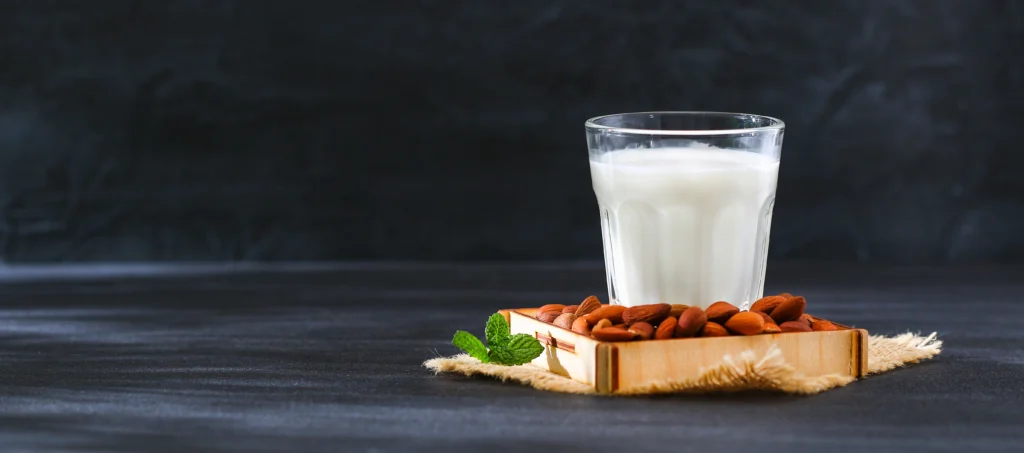
- Color: Typically white to off-white.
- Shape: Liquid form, taking the shape of its container. Available in cartons, bottles, and tetra packs.
- Size: Sold in various sizes ranging from single servings (8 oz or 240 ml) to larger family-size containers (32 oz or 946 ml and 64 oz or 1.89 liters).
- Texture: Smooth and slightly creamy, less viscous than cow’s milk, making it slightly more watery but still offering a pleasant creaminess. The texture can vary between brands, with some producing a thicker consistency.
- Aroma and Flavor: Mild, slightly nutty scent with a delicate, mildly nutty flavor. Despite being unsweetened, it has a hint of sweetness and a neutral taste that blends well with both sweet and savory dishes.
Culinary Uses:
- Common Dishes:
- Beverages: Smoothies, coffee and tea (as a creamer), hot chocolate.
- Breakfast: Cereal and oatmeal, pancake and waffle batters.
- Baking: Cakes, muffins, cookies, puddings, custards.
- Cooking: Soups (like tomato bisque), sauces (like Alfredo), mashed potatoes, dairy-free ice cream.
- Preparation Methods:
- Can be consumed cold directly from the container.
- Can be gently heated for use in hot beverages or recipes; avoid boiling to prevent curdling.
- Frequently blended into smoothies and shakes for a creamy consistency.
- Used in equal parts as a substitute for cow’s milk in baking recipes.
- Stirred into soups, sauces, and other dishes to add creaminess.
- Suitable Pairings:
- Fruits: Berries, bananas, apples.
- Grains: Cereals, oatmeal, quinoa, rice.
- Nuts and Seeds: Chia seeds, flaxseeds.
- Vegetables: Creamy vegetable soups, mashed potatoes.
- Sweeteners and Spices: Natural sweeteners (like honey or maple syrup) and spices (such as cinnamon and vanilla).
Geographical Information:
- Origin: Almond milk has historical roots dating back to medieval Islamic, European, and Middle Eastern cuisines, where it was used as a dairy substitute during fasting periods.
- Primary Growing Regions for Almonds:
- California, USA: The largest producer, accounting for over 80% of the world’s almonds.
- Mediterranean Countries: Spain and Italy, leveraging favorable climates.
- Australia: Increasing almond cultivation.
- Seasonal Availability: Available year-round due to modern processing and storage methods. The almonds are typically harvested in late summer to early fall, but the processed product is consistently available throughout the year. Refrigerated almond milk should be kept cold and typically lasts about 7-10 days after opening.
In essence, unsweetened, plain, refrigerated almond milk is a versatile, healthy, and widely available dairy alternative with a mild flavor and smooth texture. It is suitable for various culinary applications, offering a low-calorie option enriched with essential nutrients, and is accessible throughout the year.
| Proximates: | |
| Water | 96.5 g |
| Energy (Atwater General Factors) | 19 kcal |
| Nitrogen | 0.1 g |
| Protein | 0.66 g |
| Total lipid (fat) | 1.56 g |
| Ash | 0.6 g |
| Carbohydrates: | |
| Carbohydrate, by difference | 0.67 g |
| Fiber, total dietary | <0.75 g |
| Sucrose | 0.04 g |
| Glucose | <0.25 g |
| Fructose | <0.25 g |
| Lactose | <0.25 g |
| Maltose | <0.25 g |
| Galactose | <0.1 g |
| Minerals: | |
| Calcium, Ca | 158 mg |
| Iron, Fe | 0.12 g |
| Magnesium, Mg | 8.2 mg |
| Phosphorus, P | 19 mg |
| Potassium, K | 49 mg |
| Sodium, Na | 59 mg |
| Zinc, Zn | 0.08 mg |
| Copper, Cu | 0.027 mg |
| Manganese, Mn | 0.056 mg |
| Vitamins and Other Components: | |
| Thiamin | 0.005 mg |
| Riboflavin | 0.083 mg |
| Niacin | 0.089 mg |
| Vitamin B-6 | <0.01 mg |
| Biotin | 1.42 µg |
| Folate, total | <0.6 µg |
| Vitamin B-12 | 0.45 µg |
| Retinol | 61 µg |
| Vitamin D (D2 + D3), International Units | 63.6 IU |
| Vitamin D (D2 + D3) | 1.59 µg |
| Vitamin D2 (ergocalciferol) | 1.58 µg |
| Vitamin D3 (cholecalciferol) | 0.01 µg |
| Vitamin K (phylloquinone) | <0.1 µg |
| Vitamin K (Dihydrophylloquinone) | <0.1 µg |
| Vitamin K (Menaquinone-4) | <0.1 µg |
| Amino acids: | |
| Tryptophan | 0.001 g |
| Threonine | 0.01 g |
| Isoleucine | 0.026 g |
| Leucine | 0.046 g |
| Lysine | 0.031 g |
| Methionine | 0.001 g |
| Phenylalanine | 0.042 g |
| Tyrosine | 0.019 g |
| Valine | 0.018 g |
| Arginine | 0.092 g |
| Histidine | 0.014 g |
| Alanine | 0.029 g |
| Aspartic acid | 0.078 g |
| Glutamic acid | 0.138 g |
| Glycine | 0.045 g |
| Proline | 0.031 g |
| Serine | 0.02 g |
| Hydroxyproline | <0.01 g |
| Cysteine | 0.001 g |